
Fire Suppression · Life Safety Systems

Fire suppression systems that protect your equipment and pass the discharge test

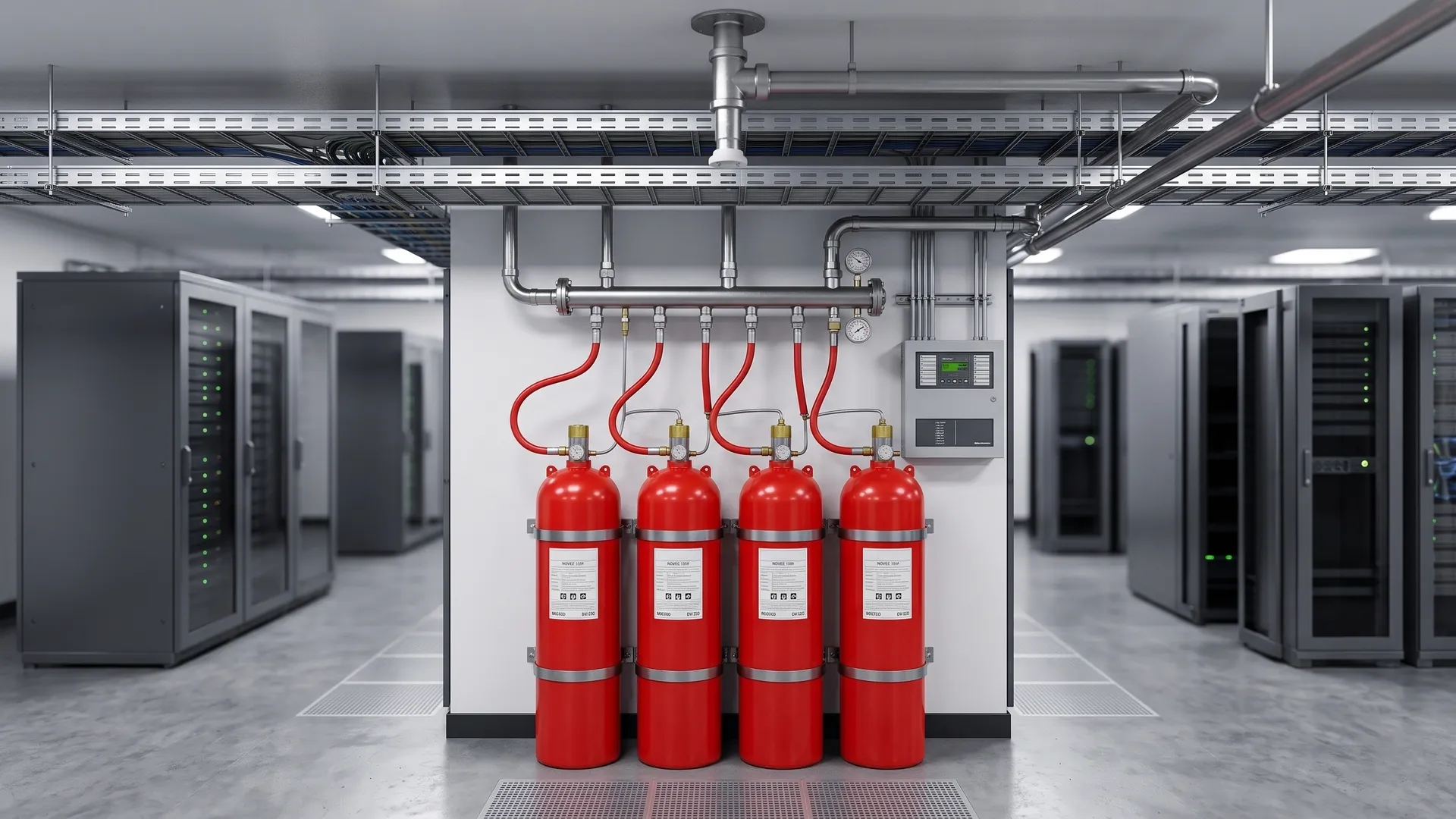
Clean-agent fire suppression system protecting a data centre server room
100%
of protected zones function-tested and the room integrity verified before you sign the handover certificate

Clean-agent, gas, aerosol and kitchen suppression, designed to NFPA 2001 and proven before handover.

You don't need a cylinder of gas in a cupboard. You need a fire suppression system that detects a fire early, floods the right space with the right agent, and puts it out before it reaches your servers, switchgear or kitchen line. This page covers clean-agent, gas, aerosol and kitchen suppression for data centres, server and electrical rooms, archives and commercial kitchens, where water would cause more damage than the fire. You get a system designed to NFPA 2001 (2022), with the protected room integrity-tested and every zone checked before handover.

Clean-agent & special-hazard designNFPA 2001 (2022) compliantRoom-integrity tested at handover
Life safety systems overview
Tell us about your room and a fire and life safety engineer replies, not a sales representative.
What it is

What is included in a fire suppression system?

A fire suppression system detects a fire in its earliest stage and releases an extinguishing agent (clean-agent gas, carbon dioxide, inert gas, aerosol or wet chemical) to put it out in seconds, before heat and flame spread. It protects the spaces where a water sprinkler would cause more damage than the fire itself: data centres, server and electrical rooms, archives and commercial kitchens. A complete scope covers the hazard survey, the agent and its storage, the detection and release controls, integration with your fire alarm, and the testing and documentation from design through handover.
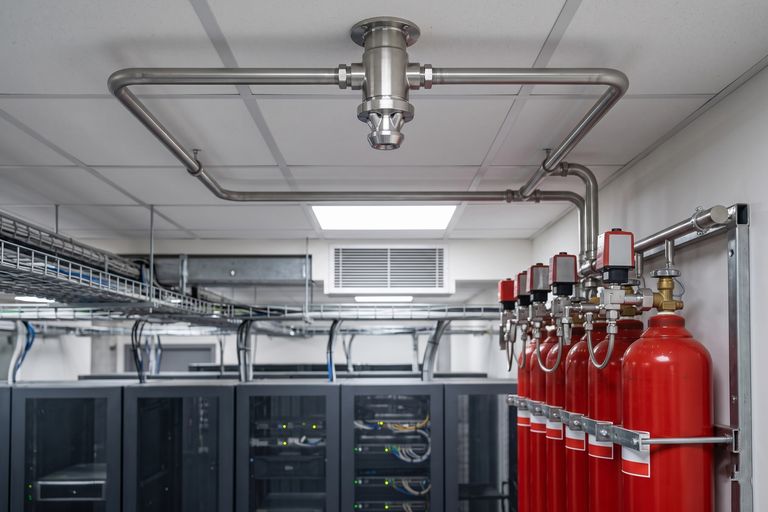
Fire suppression discharge nozzle and gas cylinder manifold in a server room

Hazard survey and agent selection

Room volume, what you are protecting and the fire risk decide the agent, sized from a survey rather than a catalogue.

Clean-agent gas suppression (NOVEC 1230, FM200)

Zero-residue gas that puts out a fire in seconds without harming electronics, for data centres, server rooms and archives.

CO2 and inert gas systems

Carbon dioxide and inert gas (nitrogen, argon) for electrical rooms and unoccupied industrial spaces where a residue-free flood suits the hazard.

Condensed aerosol systems

Compact, particle-based units for small enclosures, sealed electrical panels and rooms where cylinders and pipework will not fit.

Kitchen suppression (wet chemical)

Hood-mounted wet-chemical systems for commercial kitchens, designed to NFPA 17A and NFPA 96 for grease and cooking-oil fires.

Detection, control and handover

Cross-zoned detection, the release panel, alarm and shutdown integration, the room-integrity test and as-built documentation.

The hazard, room volume and agent are agreed and approved before any cylinder, nozzle or pipework is ordered. Nothing is procured until the design is confirmed.

Risks

Where fire suppression systems fail, and how we prevent it

Four failures that show up at the worst possible moment: a real fire, or an authority inspection. Each one is preventable at design stage.

Risk 01

The agent leaks out of the room before it can work

A clean-agent or gas system only works if the room holds the agent at its design concentration long enough to put the fire out, usually a ten-minute hold. If the room is never integrity-tested, the gas escapes through cable penetrations, gaps under doors and ceiling voids within seconds of discharge. The cylinders empty, the panel logs a discharge, and the fire is still burning. We have opened rooms where the agent had drained into the false floor before anyone reached the door.

10 min hold
gone in under two minutes when the room was never sealed.
Prevention

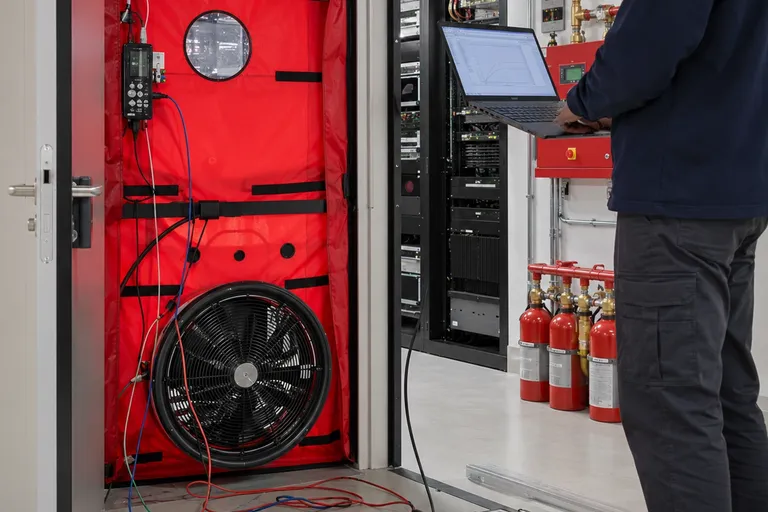
You get a door-fan integrity test at design and again at handover, with every cable, pipe and duct penetration sealed before sign-off.

Specification

What a compliant fire suppression system specification includes

Fire suppression at Yakkaservices starts from the hazard, not the product. The agent is selected for what you are protecting and whether the room is occupied, then the quantity is calculated for the room volume to reach and hold the design concentration. Clean-agent and inert gas suit occupied electronic spaces, carbon dioxide suits unoccupied hazards, aerosol suits small sealed enclosures, and wet chemical suits kitchen hoods. Before handover, the room integrity, the cause-and-effect and every zone are tested and recorded. The standards below are the baseline, and your subject-matter expert confirms the agent and editions in force for your project.
Standards
Clean-agent systems to NFPA 2001 (2022) and ISO 14520; carbon dioxide to NFPA 12; kitchen wet-chemical to NFPA 17A and NFPA 96; detection to NFPA 72 (2022). UAE projects designed to the UAE Fire and Life Safety Code of Practice
Clean-agent systems
NOVEC 1230 (FK-5-1-12) or FM200 (HFC-227ea), design concentration set for the hazard, discharge inside 10 seconds and a minimum ten-minute hold
CO2 and inert gas
High-pressure carbon dioxide for unoccupied spaces; inert gas (nitrogen and argon blends, IG-541 or IG-55) where a residue-free, non-conductive agent suits an occupied room
Aerosol systems
Condensed aerosol generators for sealed enclosures and electrical panels; no pipework and no pressurized cylinders, minimal footprint
Kitchen suppression
Wet-chemical hood system with appliance-specific nozzles, automatic gas and electric shutoff and a manual pull station, to NFPA 17A and NFPA 96
Detection and control
Cross-zoned (double-knock) smoke detection, a dedicated release panel, manual release and abort stations, and audible and visual discharge warning
Integration
Cause-and-effect link to the fire alarm: air-handling and damper shutdown, power trip, alarm signalling and BMS status, agreed and tested
Testing method
Door-fan room-integrity test, cause-and-effect verification and a witnessed function test across every zone, recorded in the handover package
Handover documentation
Editable as-built drawings · concentration and pipe-network calculations · room-integrity report · signed cause-and-effect matrix · agent quantity certificates · O&M manuals · operator training
Warranty
Manufacturer warranty on cylinders, agent and detection, activated at certified handover, with the refill and service schedule defined
Engineer running a door-fan room integrity test on a fire suppression system
Room-integrity report, concentration calculations and editable as-builts included as standard.
Cost factors

What drives the cost of a fire suppression system up or down

We do not publish fixed prices, because the agent and the room decide the figure, and two rooms the same size can differ widely once these six factors are set. Each one is decided at design, not on site. A fire suppression assessment gives you an indicative range for your scope.
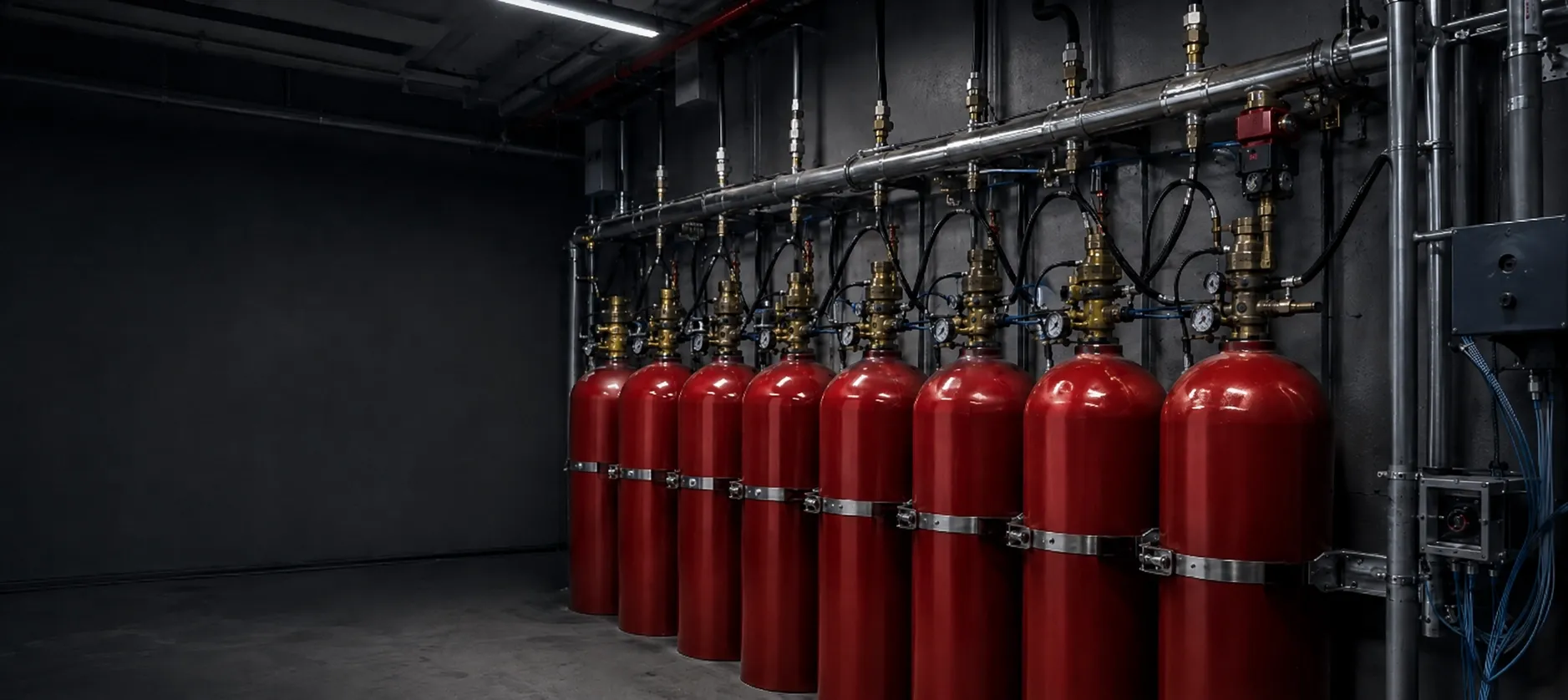
Clean-agent suppression agent cylinders in storage
Agent type and volume

Clean-agent and inert gas cost more per cubic metre than carbon dioxide or aerosol, and the room volume sets how much agent and how many cylinders you need.

Room volume and sealing

A larger room needs more agent, and a leaky room needs sealing work before it can hold the agent long enough to pass the integrity test.

Number of protected zones

Each protected zone adds its own detection, nozzles and often a selector valve or dedicated cylinder bank.

Detection and control

Cross-zoned detection, the release panel and abort stations add cost; aspirating very-early-warning detection adds more where the risk justifies it.

Integration and shutdown

Damper actuators, power-trip interfaces, the fire alarm link and BMS points all add to a system that has to isolate the room on alarm.

Kitchen and special hazards

For kitchens, the appliance count and hood length set the nozzle count; special hazards such as turbines or paint booths need bespoke design.

Standard exclusions(not included in a suppression quote)
Builder's work, core drilling and making good
Room sealing beyond the agreed allowance where existing penetrations fail the integrity test
Civil Defence and authority submission and inspection fees
Electrical supply to the release panel, where by others
HVAC dampers and actuators supplied by the mechanical contractor
Annual maintenance contract (AMC) and agent refill after a discharge
Process

How we design, install, and certify your fire suppression system

Every project follows five phases in sequence. No phase begins until the previous one is complete and documented. Nothing is procured until the design and calculations are approved. Nothing is handed over until the room integrity and cause-and-effect are proven.

01

Hazard survey and design

Your project starts with a hazard survey. We record the room volume and construction, what you are protecting and whether it is occupied, then calculate the agent quantity and design concentration and produce the zone layout and cause-and-effect schedule.

No cylinder, nozzle or pipework ordered until the design and concentration calculations are approved.
02

Room preparation and containment

Cable, pipe and duct penetrations are sealed, and the damper and power-trip points are confirmed with your mechanical and electrical teams. The room is prepared so it can hold the agent for the full design hold time.

Room-integrity targets agreed before any cylinder or detection device is installed.
03

Installation

Cylinders, pipework, nozzles, detectors, the release panel and the manual release and abort stations are installed and terminated to the design. Every device is labelled to match the cause-and-effect schedule.

Every device labelled and terminated to the design before commissioning begins.
04

Integration and commissioning

The cause-and-effect is commissioned: detection, dampers, air-handling shutdown, power trip and alarm signalling are proven to operate together. A door-fan integrity test confirms the room holds the agent, and each zone is function-tested.

Room integrity and the full cause-and-effect proven before handover.
05

Authority approval and handover

The approval pack is submitted and the witnessed test is completed with the authority. Handover is not signed until the as-built drawings, calculations, room-integrity report, agent certificates and operator training are produced, reviewed and accepted.

Not signed off until the witnessed test passes and every document and the training are accepted.
Key comparison

Clean agent, inert gas or aerosol: which suppression system fits your room?

The agent you choose for a critical room shapes how it puts out a fire, how much storage it needs, and what it costs to refill. Choosing an agent from a brochure, without matching it to the room volume, the storage space and whether people work in there, is the most common reason a suppression system is wrong before it is even installed.

Compare options
Select a category
Best for
Data centres, server and electrical rooms
Large data halls, occupied rooms, long pipe runs
Small enclosures, panels, rooms with no plant space
Residue
None, electrically non-conductive
Light residue, usually wiped down
Storage space
Compact low-pressure cylinders near the room
Many high-pressure cylinders, more floor space
Minimal, units mounted inside the space
Occupied-room safety
Safe at design concentration
Safe, reduces oxygen to a controlled level
Best suited to sealed or unoccupied enclosures
Hold and re-entry
Ten-minute hold, quick re-entry once ventilated
Holds in a sealed space, ventilate before re-entry
Relative cost
Moderate agent cost, compact install
Higher footprint, lower environmental impact
Lowest install cost, smaller coverage

For a typical data centre, server room or electrical room, a clean-agent system is the most defensible choice: no residue, compact storage and fast re-entry. For a large data hall, a long pipe run or where you want the lowest environmental impact, inert gas is worth the extra footprint. For a single panel or a small enclosure with no room for cylinders, condensed aerosol does the job at the lowest cost. The right answer is set by your room volume, your storage space and whether people work inside, which is what the assessment confirms.

Cross-service

What your fire suppression system needs to connect to

A fire suppression system rarely stands alone. It takes its trigger from detection, shares the building with water-based fire fighting, and depends on the building services shutting down on alarm. Leaving these links out of scope creates coordination gaps during installation and finger-pointing after handover.

Fire and gas detection

Suppression only releases when detection tells it to. Cross-zoned smoke and gas detection, and the logic that confirms a real fire before discharge, are designed together with the suppression so the two never disagree.

View fire gas detection systems

Fire fighting systems

Gas and clean agent protect the critical rooms; water-based sprinklers and hydrants protect the rest of the building. Designing both together means each space gets the right agent and the coverage has no gaps.

View fire fighting systems

Building management system

On alarm, the suppression has to shut dampers, stop air handling and trip power, then report its status. Those links belong in the BMS integration, decided at design stage, not patched in later.

View BMS services

Structured cabling and ICT

The data centres and server rooms you are protecting run on structured cabling, and every cable penetration into a gas-protected room has to be sealed to hold the agent. The cabling and the suppression share the same room.

View structured cabling
Relevant industriesData centresManufacturingOil & gasHospitalityHealthcare
FAQs

Fire suppression system questions buyers ask

The questions buyers ask about fire suppression systems before going to tender.

A sprinkler puts out a fire with water; a fire suppression system uses a gas, chemical or aerosol agent instead, for places where water would cause more damage than the fire. The main types are clean-agent gas (NOVEC 1230, FM200) and inert gas for data centres and electronic rooms, carbon dioxide for unoccupied industrial spaces, condensed aerosol for small enclosures, and wet chemical for commercial kitchens. Sprinklers protect the building as a whole; suppression protects the specific rooms where downtime or equipment loss is the real risk. Most buildings need both.

For most server rooms and data centres, a clean-agent system using NOVEC 1230 or FM200 is the usual choice, because it leaves no residue, is safe for electronics, and lets your team back in quickly once the room is ventilated. Inert gas suits larger data halls and long pipe runs. The deciding factors are the room volume, the storage space you have for cylinders, and how the room is sealed. An assessment sizes the agent to your specific room rather than to a standard model.

Yes, clean-agent systems are designed to be safe for people at the concentration used to put out the fire, which is why they suit occupied server and control rooms. The system still gives an audible and visual warning and a time delay before discharge, and a manual abort station lets anyone in the room hold the release. Carbon dioxide is the exception: it is only used in unoccupied spaces because it works by displacing oxygen.

Because a gas system only works if the room holds the agent at its design concentration for the full hold time, usually ten minutes. A door-fan integrity test measures how quickly the room leaks through cable penetrations, gaps and voids, and tells you whether the agent will stay long enough to put the fire out. Skipping this test is the most common reason a system discharges and still fails. We run it at design and again at handover, and seal any leaks before sign-off.

The cost depends on the agent, the volume of the space, the number of zones and how well the room seals, so there is no single price. A clean-agent system for a large data hall costs far more than an aerosol unit in one electrical room. We do not publish fixed figures because the room decides the number, but a fire suppression assessment gives you an indicative range and a scope you can use to compare proposals fairly.

A fire suppression system needs a regular inspection of the cylinders, agent pressure, detection and release controls, plus a check that the cause-and-effect still operates. Clean-agent cylinders are weighed or pressure-checked on a schedule set by the standard, and the agent is refilled after any discharge. We define the inspection schedule and exclusions in an annual maintenance contract (AMC) before you sign, so there are no surprises about what is and is not covered.

Honest fit

When we are the right choice, and when we are not

We will tell you directly when your project is not the right fit. These are the three situations where you should look elsewhere.

You need one extinguisher or a plug-in panel unit

A local fire supplier will fit a portable extinguisher or a small self-contained panel unit faster and cheaper than we will. We earn our place on engineered systems that are calculated for the room, integrity-tested and handed over documented. If your need is a single device, we will say so at the first conversation.

Your tender is scored on lowest price only

If the scope leaves out the concentration calculations, the room-integrity test or the witnessed authority approval, we will not win that tender, and we will not strip those steps to match a lower number. A proposal without them is a different scope, not a cheaper one.

You only need water sprinklers for general areas

If your building needs water-based sprinklers or hydrants for general floors and car parks, that is a fire fighting scope, not gas suppression. A sprinkler contractor, or our fire fighting team, is the right route. We focus on the critical rooms where water would do more harm than the fire.

You're a good fit if…

Your project is a data centre, server or electrical room, archive or commercial kitchen where water is the wrong answer, where the system has to be calculated for the room, integrity-tested and integrated with detection and the building services, and where it must pass authority approval and stay documented and serviceable for years.

Book a fire suppression assessment

A suppression scope you can test every proposal against

Book a fire suppression assessment and a fire and life safety engineer will survey your room, recommend the agent, and give you a zone layout and an indicative budget range. You can then hold every contractor proposal against the same scope, instead of comparing numbers that quietly cover different work.

A fire and life safety engineer contacts you, not a sales representative
Response within one business day
Recommended agent, indicative zone layout and budget range in writing within five business days of the site visit
No obligation. If we are not the right fit, we will tell you directly

Tell us about your project

Response within one business day. No obligation.