IT-park systems that keep every tower leased, reliable and tenant-ready
A network drop, a security gap between towers, or a fire system that fails its cause-and-effect test is not a snag in an IT park, it is a tenant breaking their lease. Yakkaservices designs, integrates, tests and supports the systems behind your campus under one contract: the network backbone, security, building management, fire and life safety, and AV.
What we deliver, and when we are not your best option
Yakkaservices integrates the building systems behind an IT park. Here is where that work fits, and where it does not.
When we are the right fit
When your IT park needs several systems, the network backbone, security, building management and life safety, designed, integrated and certified together across multiple towers, with one team accountable for how they work as a whole.
When a specialist contractor fits better
If you need to replace a single system in one block, one CCTV run, one fire panel, one access door, a focused specialist contractor will often do it faster. That is the right call, and we will tell you so.
When you want a tenant IT or software vendor
If you are buying your tenants’ servers, cloud, business applications or managed IT, that is tenant IT. We design the landlord base-build infrastructure those systems run on, the backbone, security, BMS and life safety, not the tenant fit-out or the applications.
Why IT parks are different
What makes IT-park building systems different
An IT park never closes
Tenants run global support desks, development centres and round-the-clock operations, so your network, power, cooling and security carry the load through nights, weekends and a power dip. When one fails quietly, your tenant finds out mid-shift and logs it against their service level, then yours.
Many tenants, one shared backbone
Each tenant needs its own secure network segment, its own access zones and its own meter, all running on infrastructure you own and share. The hard part is keeping one tenant fully isolated from another while the cabling, switches and building systems underneath stay common.
Leasing and approvals ride on the systems
SEZ and STPI benefits, the occupancy certificate and the fire NOC all depend on your building systems passing inspection before tenants move in. Across several high-rise towers, evacuation works only when fire detection, smoke control and access release act as one system.
Critical systems
The systems that keep an IT park running
Every tenant service you lease against rides on the same physical infrastructure. We design, integrate and certify these six systems so they work together, not just alongside each other.
ICT backbone & tenant networking
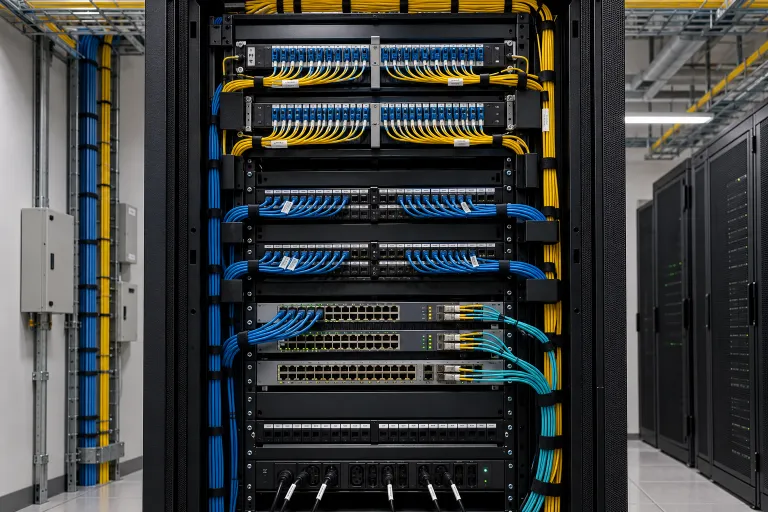
Every tenant rides the same campus backbone: internet, voice, building systems and their own corporate network. We design and certify the cabling to TIA-568-D (2018) and ISO/IEC 11801:2017, with fibre between towers and the resilience that keeps a floor online when a switch or link fails. Each tenant gets a segregated, secure segment on shared infrastructure.
Lobbies, lift access, parking, server rooms and each tenant’s suite need a different rule about who gets through the door. Access control and visitor management let you set those rules by tenant, zone, role and time, and give each tenant control of their own floors without exposing the rest of the campus.
A multi-tower campus, its perimeter, parking and common areas need coverage one control room can actually watch. We design camera placement from a site survey, size storage for your real retention period, and bring it into a single command centre so security sees the whole campus, not six disconnected systems.
Energy is one of your largest operating costs and a number tenants ask about before they sign. The BMS runs HVAC, lighting and common-area plant, and meters energy by tenant so you can bill fairly and show consumption per floor. Built on BACnet, Modbus and KNX, so you are not locked to one vendor for future changes.
Across high-rise towers, evacuation depends on detection, smoke control and door release acting in the right sequence, tower by tower. Your addressable fire alarm triggers the right doors, dampers, lift recall and voice messages to NBC 2016, NFPA 72 (2022) and EN 54, with the commissioning evidence the fire authority asks for before occupancy.
Common-area announcements, a voice evacuation message and tenant wayfinding can share planned infrastructure. We integrate public address and voice alarm so a fire event overrides routine paging with a clear instruction by zone, with lobby digital signage, meeting-suite and auditorium AV in the same scope.
Where IT-park systems go wrong, and how the failure is prevented
Four failures that appear at commissioning or after handover. Each one is preventable at design stage.
01Failure 01
Fire systems tested in isolation, not together
The fire alarm passes on its own, the smoke control passes on its own, and nobody runs them together across the towers until the authority does. In an IT park that means a failed cause-and-effect inspection and an occupancy date that slips while you re-test, with tenants waiting on a fit-out they cannot start.
Consequence
A failed fire inspection, and an occupancy date that slips while tenants wait to fit out.
Prevention
A written cause-and-effect matrix agreed early, then a full integrated test across every tower before the authority visit, not during it.
02Failure 02
Tenant networks share a path they should not
When the campus backbone is built without proper segmentation, one tenant’s traffic, or the building OT systems, can reach a network that should be sealed off. For a tenant with their own security and compliance obligations, that is a finding in their audit and a reason to question the building. We have seen building management systems left on the same flat network as tenant data.
Consequence
A tenant audit finding, and a tenant questioning whether your building is safe to operate in.
Prevention
Segment the network at design stage, separate building OT from tenant IT, and hand over the VLAN and addressing scheme as documented evidence.
03Failure 03
A backbone sized for today, not the next tenant
Cabling, pathways and the riser are sized for the first tenants, then the next lease needs more fibre, more power or more cooling and there is no room left. The consequence is civil and containment work in an occupied tower, at your cost, while you try not to disturb paying tenants.
Consequence
Retrofit work in an occupied tower, at your cost, that disturbs tenants who already pay rent.
Prevention
Size risers, pathways and the backbone for credible growth at design stage, and leave documented spare capacity per floor.
04Failure 04
A handover with no records stalls every fit-out
The base build finishes but the as-built drawings, test results and cable schedules never arrive, so every tenant fit-out starts by surveying what is already there. The consequence is slow fit-outs, repeated site visits, and disputes about what the landlord delivered versus what the tenant must add.
Consequence
Slow tenant fit-outs and disputes over what the landlord delivered.
Prevention
Make full as-built documentation, channel test results and warranty registration a handover deliverable, in editable format, not a promise to follow.
Integration
How the systems connect in an IT park, and why that is the hard part
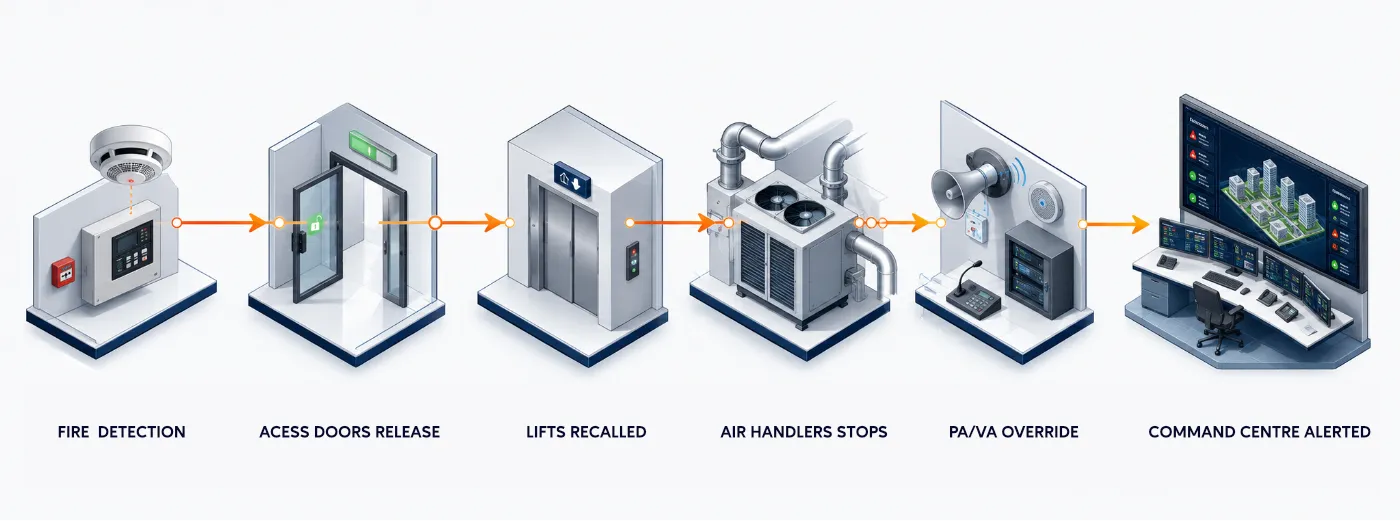
In an IT park, the systems are only as good as the points where they meet. A fire event has to release the doors, recall the lifts and override paging in the right order. None of that happens by accident. It happens because the interfaces were drawn at design stage and tested before handover.
One integrated response to a single event
Fire event detected
Access doors release
Lifts recalled
Air handlers stopped
PA/VA overrides paging
Command centre alerted
When one team designs and commissions all of it under a single contract, those interfaces are one team's responsibility. When each system is a separate contract, the gaps between them belong to no one, until the day they fail.
In an IT park
One integration partner
Single contract
Multiple specialist contractors
Separate contracts
Cross-system interfaces
fire→doors, BMS→metering, OT/IT separation
Designed and tested by one team
Fall between contracts, surface at commissioning
Cause-and-effect evidence for fire inspection
One party presents it
Each contractor points to the next
Occupancy and authority handover pack
Assembled as one package
Fragmented, gaps found late
Phasing across occupied towers
One coordinated plan across systems
Each crew schedules around its own work
After handover and tenant fit-outs
One support contract across systems
Separate contracts, disputed faults
Compliance and authority requirements
The compliance we own, by system
Compliance is easier to judge when you can see it by system. Here is what each system we deliver is designed, tested and approved against, for IT-park projects in India and Oman.
The backbone every tenant runs on
Structured cabling, fibre backbone and the data pathways that carry every tenant and building system, designed for resilience and growth.
Authority approvalTest certification at handover
Designed, tested & certified to
TIA-568-D (2018)
Structured cabling design and performance
ISO/IEC 11801:2017
Generic cabling for customer premises
IEC 60364
Low-voltage electrical installations
Across all of them, you receive the evidence at handover: test certificates, the fire cause-and-effect matrix, the network segmentation and addressing scheme, and as-built drawings.
FAQs
IT-park systems: questions buyers ask us
The questions IT-park developers, facilities teams and consultants ask before they specify.
An IT park needs the physical infrastructure that every tenant and building service runs on. That includes structured cabling and the campus network backbone, access control, CCTV and visitor management, building management for HVAC and energy metering, addressable fire and life safety, and public address with voice alarm. Tenant applications, servers and managed IT sit on top of this layer. We deliver the layer, not the tenant fit-out or their software.
By segmenting the network at design stage, not after. Each tenant runs on its own secure segment, and the building OT systems, BMS, CCTV and access control, sit on a network kept separate from tenant data. We design the VLANs, addressing and firewalling so one tenant cannot reach another, or reach the building systems, and hand over the scheme as documented evidence your tenants’ auditors can review.
Yes, with a phasing plan agreed with your operations and leasing teams before any work starts. Cutovers are scheduled into low-activity windows, occupied towers keep a tested fallback, and work in common areas is sequenced around tenants already in the building. The aim is that a tenant never loses a system they rely on while you build out the next block.
In India, an IT park needs fire authority approval against NBC 2016 and the state fire NOC, the occupancy certificate, and SEZ or STPI compliance where the park is registered under those schemes. In Oman, approvals run through the Royal Oman Police Civil Defence and the local municipality. We design to those requirements, prepare the cause-and-effect matrix and test evidence the authority asks for, and support the inspection so it passes the first time.
Because the failures in an IT park happen between systems, not inside them. When one team designs, integrates and commissions ICT, ELV, BMS, fire and AV under a single contract, the interfaces are one team’s responsibility and the handover is one package. With separate contractors, the gaps between systems belong to no one until they fail at commissioning or after tenants move in. A single integrator also gives you one support contract instead of disputed faults between vendors.
Book an IT-park infrastructure assessment
A clearer scope for your IT park, whether or not you work with us
Tell us about your IT-park project and a senior engineer reviews it with you, then sets out what your systems need and where the risks are.
An engineer who has delivered campus and multi-tower systems contacts you, not a salesperson
You get a response within one business day
No cost and no obligation for the assessment
If a single specialist contractor is the better fit, we will say so
Tell us about your IT-park project
Response within one business day. No cost, no obligation.