Oil and gas facility systems hazard-ready, certified and always available
You cannot afford a gas detector that misses a leak, a fire alarm that fails to trip the right shutdown, or a radio that drops on a remote platform. On an oil and gas site, those are not faults to log later, they are safety events. You need the ICT, fire and gas detection, security, building management and public address systems behind your facility designed, integrated, certified and supported as one, so your operations team is never the one that finds the gap. Yakkaservices delivers them under a single contract, built to NFPA 72 (2022) and hazardous-area code.
Hazardous-area Ex designNFPA 72 (2022) fire & gasFail-safe to IEC 61511One contract, fully certified
Honest scope
What we deliver, and when we are not your best option
Yakkaservices integrates the facility systems behind an oil and gas site. Here is where that work fits, and where it does not.
When we are the right fit
When your site needs several facility systems together: communications, fire and gas detection, security, building management and public address, designed, integrated and certified as one, with a single team accountable for how they work as a whole.
When a specialist contractor fits better
If you need to replace a single item, one gas detector loop, one camera run, a single fire panel, a focused specialist contractor will often do it faster. That is the right call, and we will tell you so.
When you want a process control vendor
If you are buying the DCS, SCADA, or the safety instrumented system tied to your process variables, that is process control engineering. You want a process automation vendor for that layer. We design the facility safety, security and infrastructure systems those controls run alongside, not the process control itself.
Why oil and gas is different
What makes oil and gas facility systems different
A plant that cannot simply shut down
An oil and gas facility runs continuously, and an unplanned shutdown is expensive and can be hazardous in itself. Your safety, communication and monitoring systems have to keep working through a power dip, a network fault and the next shift change. When one fails quietly, the people who find out are the operators in the field, at the worst possible moment. Maintenance and upgrades happen around a live process, under a permit to work, not during a convenient closure.
A hazardous atmosphere changes every rule
Parts of your site are classified as explosive atmospheres, where a single spark is an ignition source. In those zones every camera, detector, speaker and junction box has to be certified for the hazard, to IEC 60079 and the ATEX or local equivalent. A standard enclosure that is fine in an office is a liability at a wellhead or a tank farm. Area classification decides what equipment is even allowed, before anyone discusses performance.
Fail-safe, not fail-quiet
In most buildings a fault is an inconvenience. On an oil and gas site, a system that fails has to fail to a safe state, not sit silent. Fire and gas detection has to trip the right shutdown, close the right valve and alert the right people in the right order, every time. That behaviour is engineered to a functional safety standard, IEC 61511, and proven at commissioning, not assumed.
Critical systems
The systems that keep an oil and gas site running
Every safety and operations system on your site depends on the same physical infrastructure. We design, integrate and certify these six so they work as one, not just side by side.
Communications network and structured cabling
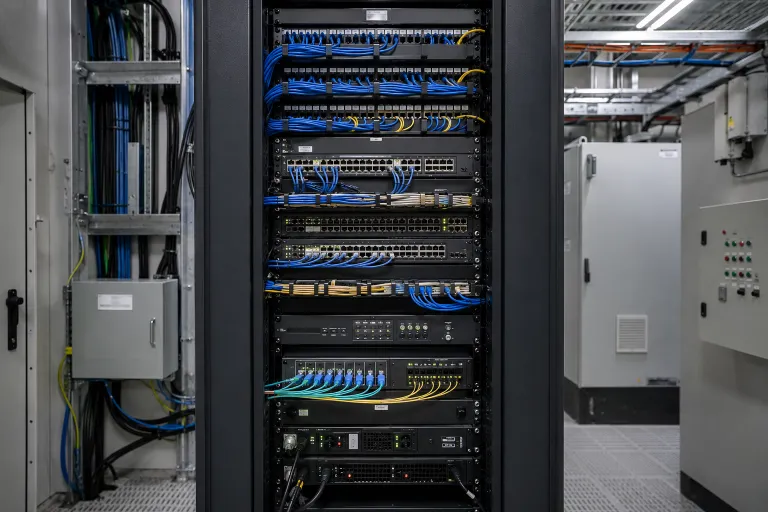
Every system on your site, from detectors to CCTV to the control room, rides the same network. We design and certify the structured cabling and fiber backbone to TIA-568-D (2018) and ISO/IEC 11801:2017, with the resilient links, radio and leaky-feeder coverage that keep a remote pad or offshore platform in contact when a path fails.
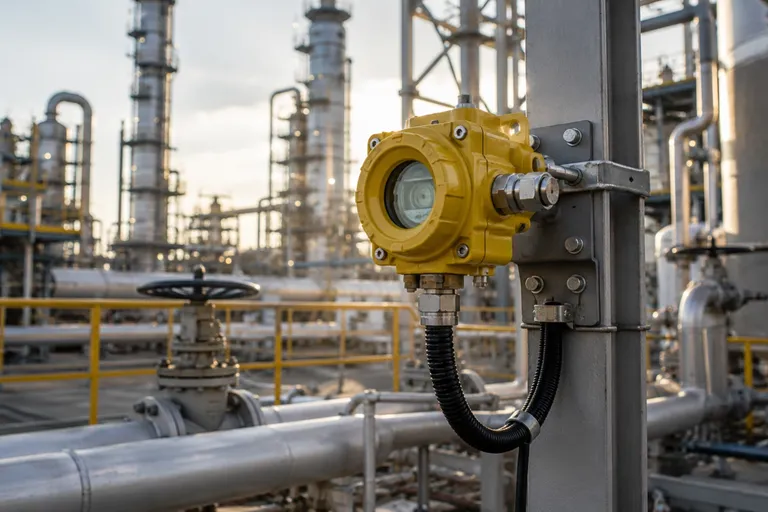
Flame and gas detectors are the first warning of a release or fire, so they have to see the hazard and act on it. We design addressable fire and gas detection that trips the right emergency shutdown, closes valves and sounds the alarm in sequence, to NFPA 72 (2022), EN 54 and API RP 14C, with hazardous-area certified devices throughout.
A pipeline corridor, a tank farm or a remote wellhead has a long, exposed boundary. We design perimeter intrusion detection, thermal cameras and fence sensors so an approach is seen early and assessed before it reaches a live asset, with detection logic tuned to cut false alarms in open terrain.
Process areas, control rooms and the explosives store each need a different rule about who gets through the door. Access control and CCTV let you set those rules by zone, role and time, with Ex-rated cameras in classified areas and an audit trail you can produce for an HSE review.
Control rooms, substations and equipment shelters have to stay within temperature and pressure limits, and your utilities have to be watched continuously. The building management system holds those conditions and shows power, HVAC and tank or utility status on one dashboard, built on BACnet, Modbus and OPC so it talks to the equipment you already run.
When an alarm sounds, every person on site has to hear a clear instruction and know where to muster. We integrate public address and general alarm (PAGA) so a fire or gas event overrides routine paging with an intelligible message by zone, with control-room video walls and AV in the same scope.
Where oil and gas systems go wrong, and how the failure is prevented
Four failures that show up at commissioning or after handover. Each one is preventable at design stage.
01Failure 01
Fire and gas detection tested in isolation, not as one
The fire panel passes on its own, the gas detection passes on its own, and nobody runs them against the shutdown logic until commissioning, or worse, until a real event. On a hazardous site that means a confirmed release that does not trip the action it should, or a spurious trip that shuts a plant down for nothing. We have been called to sites where a detector alarmed but the valve it was meant to close never moved.
Consequence
A real release that does not trip its shutdown, or a costly spurious trip that stops production.
Prevention
A written cause-and-effect matrix agreed early, then a full integrated test of detection, shutdown and alarm before commissioning sign-off, not during it.
02Failure 02
Equipment that is not certified for the zone it sits in
A camera, detector or junction box gets installed in a classified area without the right hazardous-area certification, or a certificate quietly lapses. In an explosive atmosphere that device is no longer protection, it is a potential ignition source. The gap usually surfaces at an HSE audit, after the equipment has been live for months.
Consequence
A device that becomes an ignition source, and an area that fails its hazardous-area audit.
Prevention
Area classification drawings drive an equipment register, every device certified to IEC 60079 for its zone and verified at install, with the certificates in the handover pack.
03Failure 03
A single communications path to a remote asset
A remote wellpad, pipeline station or platform is connected by one link with no second path, because redundancy looked like an avoidable cost at design stage. The day a fault takes that link down is the day an operator in the field loses contact during the incident that needs it most. Coverage that was assumed on a drawing turns out to have dead spots in the open.
Consequence
An operator or asset cut off from the control room during an incident.
Prevention
Redundant communication paths designed in, coverage surveyed and proven on site, and failover tested, before the asset goes live.
04Failure 04
An upgrade that forces an unplanned shutdown
Cutting over a network or running new cable through a live process area without a phasing plan creates two bad options, an unplanned shutdown or hot work next to running plant. Either one is a safety and production problem your operations team did not budget for. The work has to fit the plant, not the other way round.
Consequence
An unplanned production shutdown, or hot work alongside a live process.
Prevention
A phased plan agreed with operations, tied to a turnaround window where possible, with permit-to-work, isolation and a tested fallback built into the method statement.
Integration
How the systems connect on an oil and gas site, and why that is the hard part
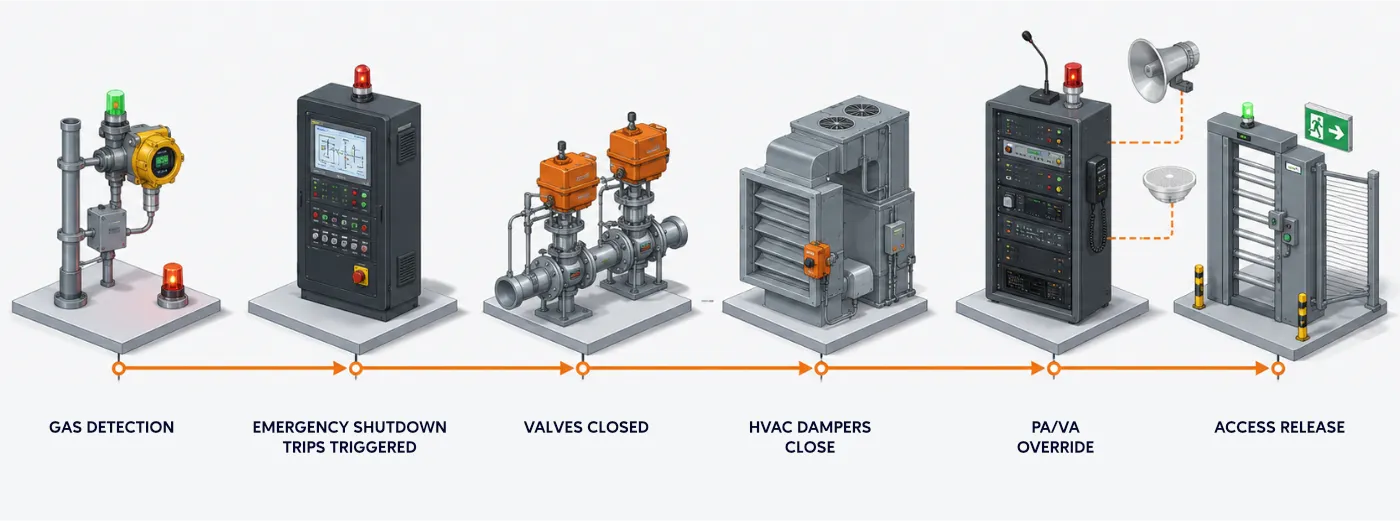
On an oil and gas site, the systems are only as good as the points where they meet. A detector is only useful if it trips the shutdown, and an alarm is only useful if everyone hears it and knows where to go. None of that happens by accident. It happens because the interfaces were drawn at design stage and proven before handover.
One integrated response to a single event
Gas or fire detected
Emergency shutdown trips
Valves close, plant isolates
HVAC dampers close
PA/VA sounds muster alarm
Access routes release, security responds
When one team designs and commissions all of it under a single contract, those interfaces are one team's responsibility. When each system is a separate contract, the gaps between them belong to no one, until the day they have to work together.
On an oil and gas site
One integration partner
Single contract
Multiple specialist contractors
Separate contracts
Cross-system interfaces
gas→ESD, detection→PA/VA, HVAC→dampers
Designed and tested by one team
Fall between contracts, surface at commissioning
Cause-and-effect evidence for sign-off
One party presents it
Each contractor points to the next
Hazardous-area and authority handover pack
Assembled as one package
Fragmented, gaps found late
Working on a live plant
One coordinated phasing plan, one permit interface
Each crew schedules around its own work
After handover
One support contract across systems
Separate contracts, disputed faults
Compliance and authority requirements
The compliance we own, by system
Compliance is easier to judge when you can see it by system. Here is what each system we deliver is designed, tested and approved against, for oil and gas projects in India, the UAE and Oman.
The network everything else runs on
Structured cabling, fiber and the radio backbone that carries every safety and operations system, designed for resilience across a spread-out site.
Authority approvalTest certification at handover
Designed, tested & certified to
TIA-568-D (2018)
Structured cabling design and performance
ISO/IEC 11801:2017
Generic cabling for customer premises
IEC 60364
Low-voltage electrical installations
Across all of them, you receive the evidence at handover: test certificates, the fire and gas cause-and-effect matrix, hazardous-area equipment certificates, and as-built drawings.
FAQs
Oil and gas systems: questions buyers ask us
The questions developers, operations teams and consultants ask before they specify.
Beyond the process control layer, an oil and gas site needs the facility systems that protect people and keep the site connected. That includes communications and structured cabling, fire and gas detection and alarm, access control, CCTV and perimeter security, building management for control rooms and utilities, and public address and general alarm. The DCS, SCADA and process safety instrumented system sit on the process side. We deliver the facility layer those controls run alongside, not the process control itself.
They act on shared logic that is designed and tested before handover. When a detector confirms gas or fire in a zone, it trips the emergency shutdown, closes the right valves, and signals HVAC to close dampers. At the same time, public address and general alarm sound the muster instruction for that zone and security releases the escape routes. The interfaces are written into a cause-and-effect matrix and proven in an integrated test, not assumed.
Yes. Every field device in a classified zone is selected and verified for the hazard against the area classification drawings, to IEC 60079 and the ATEX or local equivalent. Fire and gas detection is designed to NFPA 72 (2022), EN 54 and API RP 14C, and documented for the authority that signs it off, India PESO and OISD, UAE Civil Defence, or Royal Oman Police Civil Defence. You receive the device certificates and cause-and-effect evidence at handover.
Often yes, with a phasing plan agreed with your operations team before any work starts. Cutovers are scheduled into low-activity windows or a planned turnaround, isolation and permit-to-work are built into the method statement, and critical systems keep a tested fallback. Some work genuinely needs a shutdown, and where that is the case we will tell you early so it can be planned into a turnaround, not discovered on site.
By designing more than one path and proving coverage on site, not on a drawing. A remote pad, pipeline station or platform gets redundant links where the risk justifies it, with radio, fiber or leaky-feeder coverage surveyed and failover tested before the asset goes live. The aim is that a single fault never leaves an operator in the field without a way to reach the control room.
As early as the design or FEED stage, while the systems scope and area classification are still being set. Early involvement lets the cross-system interfaces, cable routes and hazardous-area equipment be designed in, rather than corrected on site later at higher cost. If the project is already under construction, an integrator can still take it over, but the earlier the interfaces are agreed, the fewer surprises at commissioning.
Book an oil & gas facility assessment
A clearer scope for your oil and gas site, whether or not you work with us
Tell us about your oil and gas project and a senior engineer reviews it with you, then sets out what your systems need and where the risks are.
An engineer who has delivered oil and gas facility systems contacts you, not a salesperson
You get a response within one business day
No cost and no obligation for the assessment
If a single specialist contractor is the better fit, we will say so
Tell us about your oil and gas project
Response within one business day. No cost, no obligation.