Hospitality solutions built to protect guests, cut energy cost, and pass every fire inspection
You are judged on two things at once: the stay your guest remembers, and the safety your guest never has to think about. In your hotel, the systems behind both run all day and all night, through full occupancy and through the quiet hours. When your fire alarm, your guest room controls, and your energy system are installed in isolation, the gaps surface at handover or at inspection. Yakkaservices designs, integrates, tests and supports these systems under one contract, to standards like NFPA 72 (2022) and ISO 50001.
Fire and life-safety compliantNFPA 72 (2022)ISO 50001 energy managementOne contract, fully certified
Honest scope
What we sell, and when we are not your best option
Yakkaservices integrates the building systems behind a hotel. Here is where that work fits, and where it does not.
When we are the right fit
When your hotel or resort needs several systems designed, integrated and certified together, and you want one team accountable for how they work as a whole. That is the work we are built for.
When a specialist contractor fits better
If you need to replace a single system, one fire panel, one camera run, or guest room controls in a single wing, a focused specialist contractor will often do it faster and for less. That is the right call, and we will tell you so.
When you want hotel software
If you are buying a property management system, a booking engine, a channel manager or point-of-sale software, that is hospitality software, and you want a PMS vendor. We design and integrate the physical systems those applications run on, not the applications themselves.
Why hotels are different
What makes hotel building systems different
A hotel never closes
Your restaurant, your spa, your back-of-house and your guest floors run on different rhythms, every hour of every day. Energy is your largest controllable cost, and most of it is spent heating, cooling and lighting space that no guest is using. Systems set to a fixed schedule cannot tell an occupied room from an empty one. When your controls follow real occupancy instead, the saving shows up on every night of the year.
The guest controls the room, and reviews it in public
Your guest expects to walk in and have the lights, the climate, the blinds and the television answer on the first try. When the room controls feel slow or confusing, you read about it in a review the next morning. The same guest may be asleep behind a closed door when an alarm sounds. Your guest room systems carry both jobs at once: comfort the guest notices, and safety the guest should never have to think about.
Evacuation means guiding people who do not know the building
In a hotel, the people you evacuate have never seen the floor plan, may be asleep, and may not speak the local language. A bell on its own does not move them. Your fire strategy has to wake the right zones, release the right doors, and give a clear spoken instruction that tells a stranger where to go. That only works when your fire alarm, voice alarm and access control act as one system.
Critical systems
The systems that keep a hotel running
Every system your guest touches, and every system that protects them, rides on the same physical infrastructure. We design, integrate and certify these six so they work together, not just alongside each other.
Structured cabling and the guest network
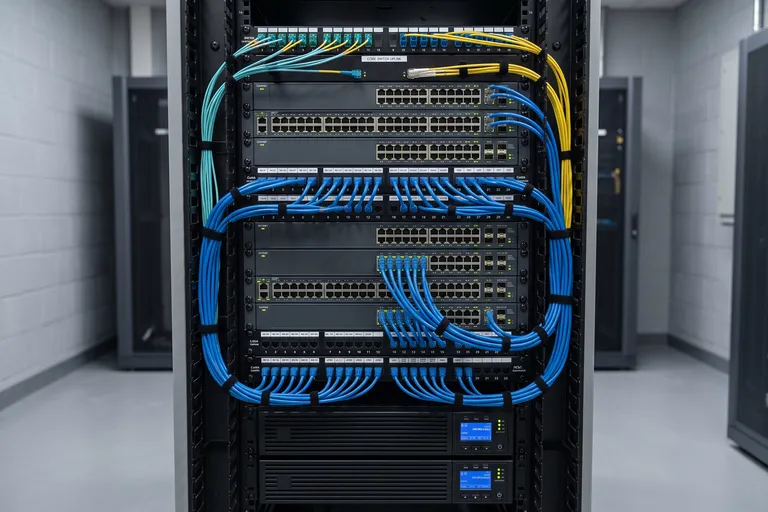
Every system in your hotel rides the same network: the property management system, the door locks, the IPTV in each room, and the WiFi your guest rates before they unpack. We design and certify the cabling to TIA-568-D (2018) and ISO/IEC 11801:2017, with the capacity and resilience to carry guest traffic and back-of-house traffic on separate, secure paths.
A guest room management system gives your guest one simple control over lighting, climate, blinds and do-not-disturb, and gives you the data behind it. When a room is sold, it wakes to the right temperature. When the guest checks out, the hotel automation system drops it to a setback so you are not paying to cool an empty room. Built on open protocols like KNX and BACnet, it talks to your PMS and your BMS instead of locking you to one brand.
Guest floors, the spa, the back-of-house and the cash office each need a different rule about who gets through the door and when. Access control and CCTV let you set those rules by zone, role and time, and tie a room key to the length of the guest's stay. Camera placement comes from a site survey, and storage is sized for the retention period your insurer and the local authority expect.
Your BMS holds the lobby, the ballroom, the kitchens and the guest floors at the right condition while showing you where the energy goes. Built on BACnet, Modbus and KNX, it links to the guest room management system so unsold rooms and empty function spaces are not heated or cooled for no one. Designed to ISO 50001, it turns energy from a fixed bill into a number you can manage.
In a hotel full of sleeping guests, your fire strategy wakes and moves people zone by zone, not all at once. Your addressable fire alarm triggers the right doors, lifts, dampers and smoke control in sequence, to NFPA 72 (2022) and EN 54, with the commissioning evidence the fire authority asks to see. We design it to clear inspection the first time, not after a list of corrections.
Your banquet halls, conference rooms and bars need AV that works without a technician on standby, and every room needs IPTV and signage that match the brand. The same speakers can carry background music and a voice evacuation message when planned that way. We integrate public address and voice alarm so a fire event overrides routine audio with a clear, intelligible instruction by zone, to EN 54-16 and EN 54-24.
Where hotel systems go wrong, and how the failure is prevented
Four failures that show up at commissioning or after opening. Each one is preventable at design stage.
01Failure 01
Guest room controls locked to one vendor
A guest room management system bought as a closed product works on day one, but cannot talk to your PMS, your BMS or your fire system without paying the same vendor for every change. Years later, a small integration or a panel swap becomes a quote you cannot compare against anyone.
Consequence
A hotel that cannot change, extend or re-tender its room systems without going back to one vendor.
Prevention
Specify open protocols (KNX, BACnet) and integration to your PMS and BMS, agreed in writing before the order is placed.
02Failure 02
Fire systems tested in isolation, not together
The fire alarm passes on its own, the smoke control passes on its own, and nobody runs them together until the authority does. In a hotel that means a failed inspection on cause-and-effect and an opening date that slips while you re-test. We have been called to projects where the door holders released but the dampers never moved.
Consequence
A failed authority inspection, and an opening date that slips while you re-test.
Prevention
A written cause-and-effect matrix agreed early, then a full integrated test before the authority visit, not during it.
03Failure 03
Energy savings promised, never delivered
A BMS and a GRMS are sold on energy saving, then commissioned to a fixed schedule that ignores whether a room is sold or a function space is empty. The hardware is installed, the saving is not, and the bill looks the same as the year before.
Consequence
An energy system you paid for that pays nothing back.
Prevention
Link the BMS to occupancy and the PMS, set the control logic to ISO 50001, and commission against a measured baseline you can hold us to.
04Failure 04
Installation that disrupts a trading hotel
Cutting over a network or running new containment through occupied floors without a phasing plan takes rooms and function space offline at the wrong time. The result is cancelled bookings, comped stays, and guests working around your contractor instead of enjoying the hotel.
Consequence
Cancelled bookings, comped rooms, and guests who remember the works, not the stay.
Prevention
A phased plan agreed with your operations team, cutovers in low-occupancy windows, a tested fallback, and noise and dust controls written into the method statement.
Integration
How the systems connect in a hotel, and why that is the hard part
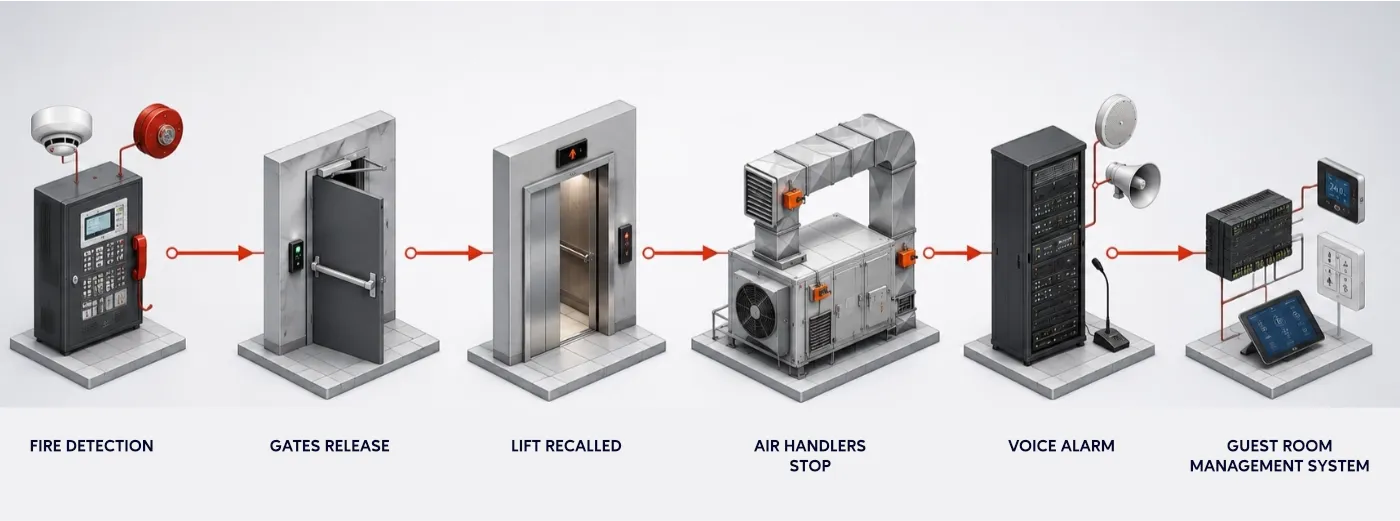
In a hotel, the systems are only as good as the points where they meet. A key that opens a door has to tell the GRMS to bring the room to life. A fire event has to reach the doors, the lifts and the speakers in the right order. None of that happens by accident. It happens because the interfaces were drawn at design stage and tested before opening.
One integrated response to a single event
Fire event detected
Guest doors release
Lifts recalled to ground
Air handlers driven safe
Voice alarm overrides music
Room lights to full, locks released
When one team designs and commissions all of it under a single contract, those interfaces are one team's responsibility. When each system is a separate contract, the gaps between them belong to no one, until the night they fail.
In a hotel
One integration partner
Single contract
Multiple specialist contractors
Separate contracts
Cross-system interfaces
fire→doors, key→GRMS, GRMS→BMS
Designed and tested by one team
Fall between contracts, surface at commissioning
Cause-and-effect evidence for fire inspection
One party presents it
Each contractor points to the next
Energy savings across BMS and GRMS
Commissioned and proven together
Each system tuned in isolation, savings lost in the gaps
Phasing in a trading hotel
One coordinated plan across systems
Each crew schedules around its own work
After opening
One support contract across systems
Separate contracts, disputed faults
Compliance and authority requirements
The compliance we own, by system
Compliance is easier to judge when you can see it by system. Here is what each system we deliver is designed, tested and approved against, for hotel projects in India, the UAE and Oman.
The network everything else runs on
Structured cabling and the data backbone that carries the PMS, the door locks, IPTV and every guest device, designed for capacity and resilience.
Authority approvalTest certification at handover
Designed, tested & certified to
TIA-568-D (2018)
Structured cabling design and performance
ISO/IEC 11801:2017
Generic cabling for customer premises
IEC 60364
Low-voltage electrical installations
Across all of them, you receive the evidence at handover: test certificates, the fire cause-and-effect matrix, energy commissioning records, and as-built drawings.
FAQs
Hotel systems: questions buyers ask us
The questions hotel developers, operators and consultants ask before they specify.
A guest room management system, or GRMS, is the control layer for a hotel room. It manages lighting, climate, blinds, do-not-disturb and service requests from one interface, and links them to the front desk and the building systems. When a room is sold it wakes to the right setting, and when it is empty it drops to a setback that saves energy. The point of a GRMS is one consistent guest experience and lower running cost, on open protocols you are not locked into.
Through interfaces designed and tested before opening, not assumed. When a guest key opens the door, access control tells the GRMS to bring the room to life. The GRMS shares occupancy with the BMS, so unsold rooms are not conditioned for no one, and the PMS tells both when a room is sold or vacated. In a fire event, the fire system overrides all of it: doors release, lifts recall, and voice alarm takes the speakers. We write these links into a cause-and-effect matrix and prove them in an integrated test.
The saving depends on your property, but it comes from one place: not heating, cooling or lighting space no guest is using. A guest room management system linked to occupancy lets unsold rooms sit at a setback, and a BMS designed to ISO 50001 does the same for public and back-of-house areas. We do not publish a fixed percentage, because an honest figure needs your occupancy pattern, your climate and your current baseline. We size the saving against a measured baseline so you can hold us to it. For a number specific to your hotel, book an assessment.
Yes, with a phasing plan agreed with your operations team before any work starts. Cutovers are scheduled into low-occupancy windows, trading areas keep a tested fallback, and noise, dust and access controls go into the method statement. The aim is that a guest never meets the works, and a function booking is never lost to them.
Each market has its own authority. In India, the project needs a fire NOC from the state fire service. In the UAE, fire and life safety systems are approved by Civil Defence. In Oman, approval sits with the Royal Oman Police Civil Defence. In all three, the systems are designed to codes such as NFPA 72 (2022) and EN 54, and the authority wants to see a cause-and-effect matrix and integrated test evidence before it signs off. We prepare that pack for submission, not after the inspector finds a gap.
As early as the design stage, while the consultant is still setting the systems scope. Early involvement lets the cross-system interfaces, GRMS protocol choice, containment routes and fire-rated cabling be designed in, rather than corrected on site later. If the project is already under construction, an integrator can still take it over, but the earlier the interfaces are agreed, the fewer surprises at commissioning and the lower the risk to your opening date.
Book a hospitality facility assessment
A clearer scope for your hotel, whether or not you work with us
Tell us about your hotel or resort project and a senior engineer reviews it with you, then sets out what your systems need and where the risks are.
An engineer who has delivered hotel systems contacts you, not a salesperson
You get a response within one business day
No cost and no obligation for the assessment
If a single specialist contractor is the better fit, we will say so
Tell us about your hospitality project
Response within one business day. No cost, no obligation.