Bank security systems audited, integrated and off your banking network
Your branch, your vault, your ATMs and your data centre each face a different threat, and each one gets audited. Bank security systems have to do more than record video. They have to prove coverage and retention when a regulator or the police ask, escalate an alarm to people who can act, and stay completely off the network your transactions run on. Yakkaservices designs, integrates, tests and supports the surveillance, access control, fire and network systems behind your bank under one contract.
RBI and IBA awareNFPA 72 (2022) and IS 2189OT and IT separation by designOne contract, fully certified
Honest scope
What we sell, and when we are not your best option
Yakkaservices integrates the physical and building systems behind a bank. Here is where that work fits, and where it does not.
When we are the right fit
When your bank needs surveillance, access control, fire and the network behind them designed, integrated and certified together, and when one team is accountable for how they work as a whole.
When a specialist contractor fits better
If you need one camera run replaced or a single alarm panel swapped in a single branch, a focused specialist will often do it faster and at lower cost. That is the right call, and we will tell you so.
When you want a cybersecurity or software vendor
If you are buying core banking software, fraud monitoring, a security operations centre, or penetration testing, that is digital security. We design and separate the physical and building systems beside it, not the banking applications or the network defence.
Why banks are different
What makes bank building systems different
Every zone is a different risk
A teller counter, a currency chest, an ATM lobby and a record store each invite a different kind of loss, so each needs its own rule about who gets in, what is watched, and how long the footage is kept. Treat a branch as one open space and you leave the highest-value rooms under the same weak control as the lobby. Your design has to follow the cash and the data, room by room.
Surveillance is evidence, not decoration
In most buildings a camera that records is enough. In a bank, the footage is evidence a regulator, an auditor or the police will ask for, often months after the event. If coverage misses the counter, or the storage overwrites before the retention period ends, you fail the audit and lose the one record that mattered. Your cameras and storage have to be sized for the rule, not for the budget left over.
Your building systems cannot touch the banking network
Cameras, door controllers and air-conditioning controls are computers on your network, and each one is a way in. Put them on the same network as your transactions and a weak camera password becomes a path toward the core banking system. Your building systems have to run on a separate, segmented network, designed that way from the first drawing.
Critical systems
The systems that keep a bank secure and running
Every system below rides the same physical infrastructure. We design, integrate and certify these six so they work together, not just sit alongside each other.
Branch and data-centre network
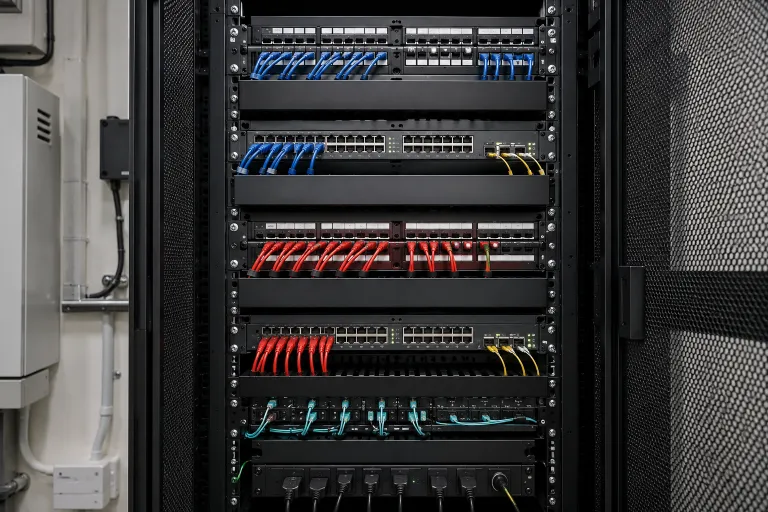
Every camera, card reader, ATM and teller terminal depends on the same cabling and network. We design and certify it to TIA-568-D (2018) and ISO/IEC 11801:2017, with the resilience that keeps a branch trading when a link or switch fails, and the segmentation that keeps these systems off your transaction network.
Cameras on the counter, the ATM, the cash room and the vault give you the evidence an audit or investigation needs. We design coverage so no high-value zone is blind, and size storage for the full retention period your regulator sets, so footage is still there when someone asks for it.
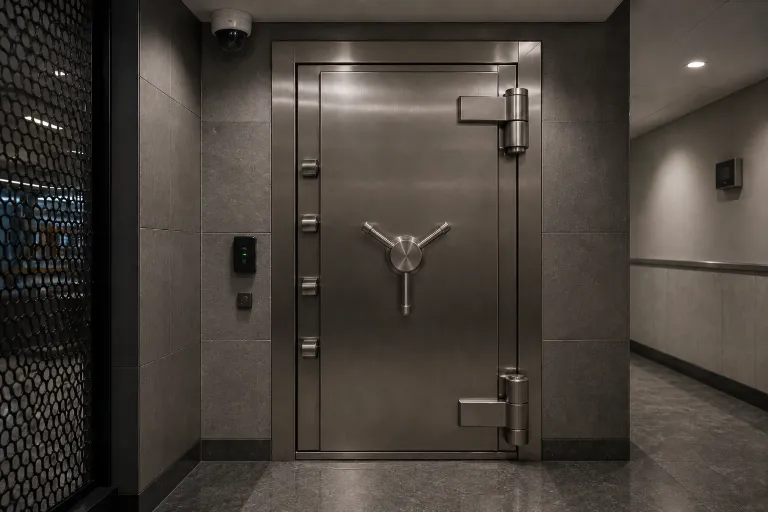
The vault, the currency chest and the server room each need their own rule about who enters, when, and with whose approval. Access control and intrusion alarms set those rules by zone, role and time, log every entry for audit, and raise a duress or after-hours alarm to a monitoring station.
Across a branch network and a data centre, the building management system holds server-room cooling in range, watches power, and shows energy use site by site. Built on BACnet and Modbus, it tells you a cooling unit is drifting before the server room overheats, not after.
A sprinkler over a server room or a record store destroys the assets it is meant to protect. We design early-warning detection and clean-agent suppression for those rooms to NFPA 72 (2022), IS 2189 and NFPA 2001, with the cause-and-effect evidence your fire approval needs.
Branch announcements, queue management and customer signage share infrastructure with voice evacuation. We integrate them so a fire event overrides routine messaging with a clear instruction by zone, and so token displays and customer screens run on managed hardware, not ad-hoc boxes.
Where bank security systems go wrong, and how the failure is prevented
Four failures that surface at audit, at inspection, or after a real incident. Each one is preventable at design stage.
01Failure 01
CCTV that fails coverage or retention at audit
The cameras work, the recorder is online, and nobody checks whether the counter is actually in frame or how many days of footage the disk really holds. Then an auditor or an investigator asks for last quarter’s recording of a specific till, and it was overwritten weeks ago. We have been called to branches where the vault camera covered the door but missed the dial.
Consequence
A failed audit, and the one recording that mattered already gone.
Prevention
Coverage mapped against every high-value zone, and storage sized for the full retention period your regulator sets, both verified at commissioning rather than assumed.
02Failure 02
Building systems sharing the banking network
To save a little cabling, the cameras and door controllers get patched into the nearest network point, which happens to carry transactions. Now every device with a default password is a doorway into the core banking network. A weak camera becomes a regulator’s finding, or worse.
Consequence
A cyber exposure that puts the transaction network one weak password away from the public lobby.
Prevention
A separate, segmented network for all building systems, designed to IEC 62443 principles and documented, so an auditor can see the transaction network is isolated.
03Failure 03
Alarms and access logs that fail silently
An intrusion alarm sounds locally but never reaches a monitoring station, or the access system records entries that no one can pull into a clean report. The system looks healthy right up to the night it is tested for real.
Consequence
An after-hours breach no one is alerted to, and entry logs you cannot produce on demand.
Prevention
Escalation paths and monitoring-station integration designed first, then commissioned against real alarm and duress scenarios, with audit-ready logging proven before handover.
04Failure 04
Fire suppression that damages what it protects
A standard sprinkler head is fitted above a server room or a record store because it was the default on the drawing. The day it discharges, water finishes the job the fire started, taking the records and servers with it.
Consequence
Critical records and servers lost to the suppression system, not the fire.
Prevention
Clean-agent suppression and early-warning detection specified for those rooms, to NFPA 2001 and IS 2189, separated from the wet system protecting the rest of the building.
Integration
How the systems connect in a bank, and why that is the hard part
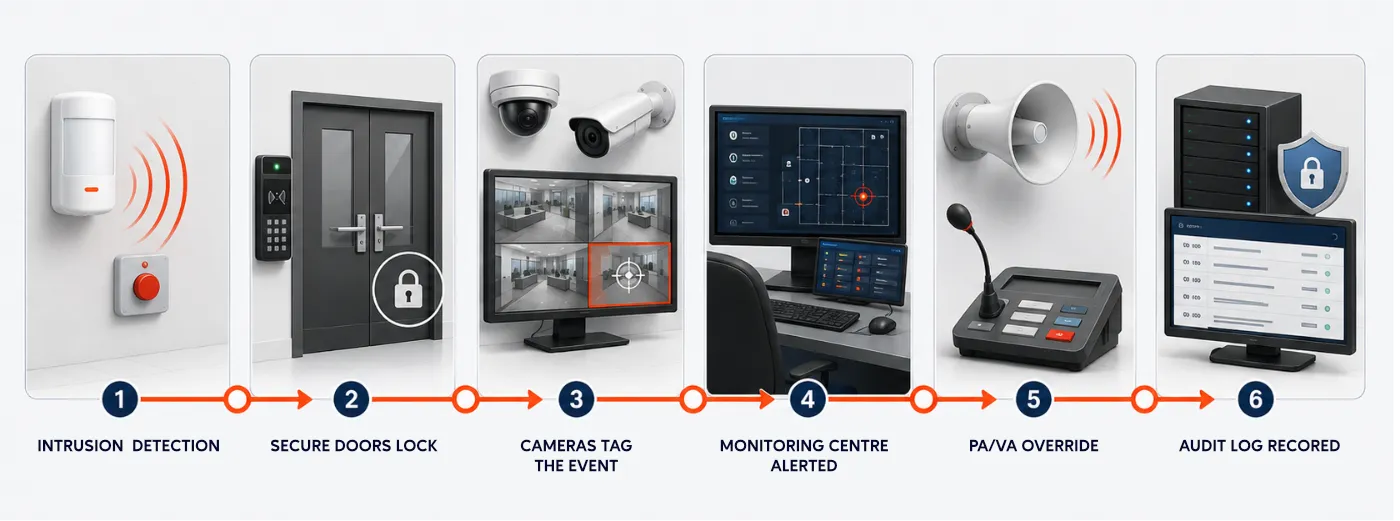
In a bank, the systems are only as good as the points where they meet. None of that happens by accident. It happens because the interfaces were drawn at design stage and tested before handover.
One coordinated response to an after-hours intrusion
Intrusion detected
Doors lock down by zone
Cameras tag and record
Alarm escalates to monitoring
Strobe and PA activate
Audit log written
When one team designs and commissions all of it under a single contract, those interfaces are one team's responsibility. When each system is a separate contract, the gaps between them belong to no one, until the night they fail.
In a bank
One integration partner
Single contract
Multiple specialist contractors
Separate contracts
Cross-system interfaces
alarm→doors, CCTV→monitoring, fire→suppression
Designed and tested by one team
Fall between contracts, surface at commissioning
Audit and inspection evidence
One party presents it
Each contractor points to the next
Network separation from the banking network
Designed and documented as one network
Each crew patches into the nearest point
Rollout across a branch network
One repeatable design and handover pack
Quality varies site by site
After handover
One support contract across systems
Separate contracts, disputed faults
Compliance and authority requirements
The compliance we own, by system
Compliance is easier to judge when you can see it by system. Here is what each system we deliver is designed, tested and approved against, for banking projects in India, the UAE and Oman.
The network everything else runs on, kept separate from banking
Structured cabling and a segmented network that carries every building system without touching the transaction network.
Authority approvalTest certification at handover
Designed, tested & certified to
TIA-568-D (2018)
Structured cabling design and performance
ISO/IEC 11801:2017
Generic cabling for customer premises
ISO/IEC 27001
Information security management
IEC 62443
Network and system security for OT/IT separation
Across all of them, you receive the evidence at handover: test certificates, the fire cause-and-effect matrix, network segmentation records, and as-built drawings.
FAQs
Bank security systems: questions buyers ask us
The questions bank developers, security and admin managers, IT teams and consultants ask before they specify.
A bank needs the physical and building systems that sit beneath its banking software, not the software itself. That means structured cabling and a segmented network, surveillance and video recording, access control and intrusion detection, building management for server-room cooling and energy, and fire detection with clean-agent suppression for sensitive rooms. Public address and customer AV usually sit in the same scope. We deliver this layer and keep it separate from your core banking and fraud systems.
Footage retention for a bank is set by your regulator, not by the size of the recorder someone happened to buy. In India, RBI and IBA guidance drives how long recordings of branches, ATMs and cash areas must be kept, and the period can run to several months for high-value zones. We size storage for the full period your compliance team confirms, then verify the real retention at commissioning so it holds up at audit. Check the current circular with your compliance team, because the figure is updated from time to time.
Because each camera, card reader and controller is a small computer, and on the wrong network it becomes a route into your transactions. If a building device with a default password sits on the same network as core banking, a minor weakness turns into a regulator’s finding or a breach. We design all building systems onto a separate, segmented network, following IEC 62443 principles, and document the separation so an auditor can see it. Your transaction network stays isolated from the lobby.
Clean-agent suppression, not a water sprinkler, suits a bank server room or record store. A sprinkler discharge over servers or paper records destroys the assets you are trying to protect, so those rooms need gas-based suppression to NFPA 2001 with early-warning detection. The rest of the building can stay on the standard wet system. We design the two so they are separated and both sign off under your fire approval.
Yes, with a phasing plan agreed with your branch and security teams before any work starts. Cutovers are scheduled into closed hours or low-traffic windows, the existing alarm and surveillance keep a tested fallback, and no high-value zone is left unwatched during the change. The aim is a branch that keeps trading, and keeps its audit cover, while the systems are upgraded.
Yes, the systems are designed and documented to support RBI and internal bank audit requirements. Audits look for evidence that surveillance covers the right zones, footage is retained for the set period, entries to secure areas are logged, and life-safety systems were tested. We hand over the coverage maps, retention settings, access logs and cause-and-effect records those audits ask for. Final audit outcomes also depend on your operating procedures, which sit outside our scope.
Book a banking facility assessment
A clearer scope for your bank, whether or not you work with us
Tell us about your bank project and a senior engineer reviews it with you, then sets out what your systems need and where the risks are.
An engineer who has delivered bank systems contacts you, not a salesperson
You get a response within one business day
No cost and no obligation for the assessment
If a single specialist contractor is the better fit, we will say so
Tell us about your bank project
Response within one business day. No cost, no obligation.