Data centre solutions built for uninterrupted uptime, compliance and security
You cannot afford a data centre that goes dark, fails an audit, or lets the wrong person into the white space. Yakkaservices designs, integrates, tests and supports the systems behind your facility under one contract: structured cabling, power and cooling controls, physical security, fire suppression, and the operations display.
What we sell, and when we are not your best option
Yakkaservices integrates the building systems behind a data centre. Here is where that work fits, and where it does not.
When we are the right fit
When your data centre needs several systems designed, integrated and certified together, and you want one team accountable for how they work as a whole. That covers structured cabling, power and cooling controls, physical security, and fire suppression.
When a specialist contractor fits better
If you need to replace a single system, one cooling unit or one camera run, a focused specialist contractor will often do it faster and cheaper. That is the right call, and we will tell you so.
When you want IT hardware or DCIM software
If you are buying servers, storage, or a data centre infrastructure management (DCIM) platform, that is IT procurement, and you want a hardware or software vendor. We design the physical infrastructure those systems run on, not the compute or the DCIM application.
Why data centres are different
What makes data centre building systems different
A data centre never goes offline
Your racks run through the night, through a grid dip, through a failed cooling unit. Uptime is the product, and a Tier rating only counts if you can service power or cooling without taking the floor down. That is concurrent maintainability, and it has to be designed into every system, not added later. When one component fails quietly with no redundancy behind it, you find out as an outage.
Heat and power are the real load
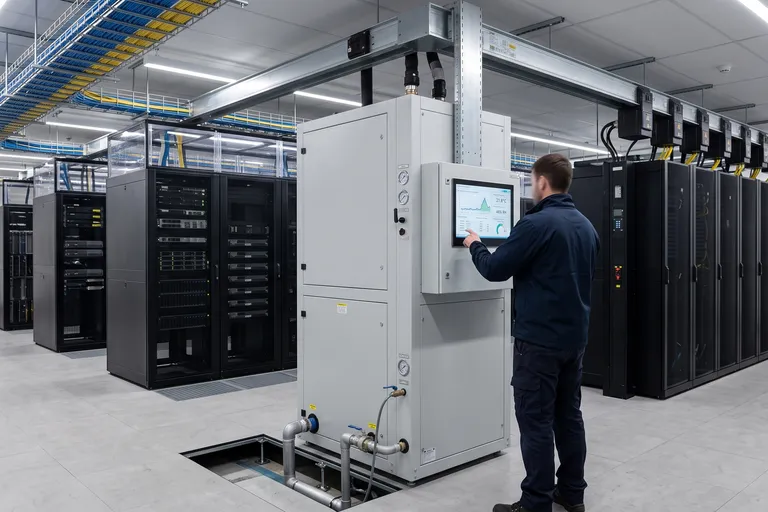
A full rack can shed more heat than a row of offices, and that heat never stops. Your cooling has to hold the ASHRAE TC 9.9 temperature and humidity envelope continuously, with power and cooling metered so you see the trend before it becomes a trip. When a data centre cooling system drifts out of range, you have minutes before equipment throttles or shuts down, not hours.
Security is physical and digital at once
An audit asks who reached the white space, when, and what they touched. Your access control and CCTV have to log entry down to the cage or rack, with the footage tied to the event. At the same time, your building systems must sit on a network segmented from the IT they support, so the cooling controls never become a way into your data.
Critical systems
The systems that keep a data centre running
Every workload you run sits on the same physical infrastructure. We design, integrate and certify these five systems so they work together, not just alongside each other.
Structured cabling and the data network
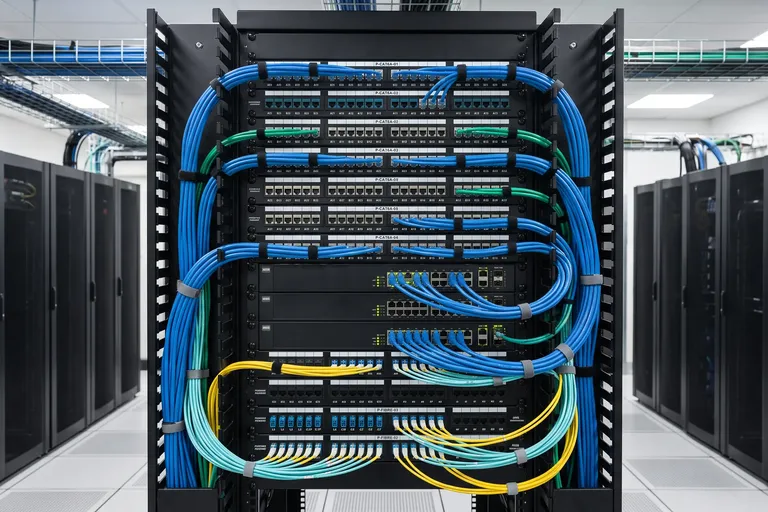
Every service in your facility rides this layer, from the storage fabric to the building systems themselves. We design and certify high-density data centre structured cabling to TIA-942 and TIA-568-D (2018), with the containment, labelling and test records that keep a busy white space maintainable. When a link or path fails, the redundancy is already there.
Your cooling and power are only as reliable as the controls watching them. The building management system holds the ASHRAE TC 9.9 envelope, meters power and cooling so you can track PUE, and alarms on a drift before it trips the floor. Built on BACnet and Modbus, it shows the load by room and by rack row.
A data centre audit turns on who reached the white space and when. We integrate access control and CCTV so entry is logged to the cage or rack, footage is tied to the event, and lock-down rules are set by zone and role. Data centre physical security is built to leave the audit trail your compliance team needs.
Water is the last thing you want near live racks, so detection has to be early and suppression has to be clean. We design aspirating smoke detection to catch a fault at the smouldering stage, with a clean-agent or inert-gas data centre fire suppression system to NFPA 75 and NFPA 2001. The release interlocks with cooling shutdown and door control, proven by a cause-and-effect test.
Your operations team has to see the whole floor at a glance. We design the network operations centre video wall and the AV that pulls building management, security and network alarms onto one display. When an event fires, the right view is already on the screen in front of the people who respond.
Where data centre systems go wrong, and how the failure is prevented
Four failures that appear at commissioning or after handover. Each one is preventable at design stage.
01Failure 01
Suppression and cooling tested apart, not together
The clean-agent system passes its own discharge test, the cooling passes its own test, and nobody runs them together until something real happens. The gas releases to hold a concentration, but the cooling units keep pushing air and vent it in minutes. We have been called to rooms where the suppression discharged correctly and the agent was gone before it could do its job.
Consequence
A discharge that empties the agent in minutes and leaves the fire unchecked.
Prevention
A written cause-and-effect matrix that shuts down air handling on alarm, proven in an integrated test before handover, not after an event.
02Failure 02
Redundancy that fails the moment you maintain it
A facility is sold as Tier III, but the cooling or power shares a component that has to come down for service. The day you maintain it, the floor has no backup, and a second fault becomes an outage. We have seen single points of failure hidden in the controls rather than the plant, where the BMS itself was the weak link.
Consequence
A planned maintenance window that turns into unplanned downtime.
Prevention
Design the control and power paths for concurrent maintainability from the start, and test a failover before the floor goes live.
03Failure 03
An access log that cannot answer the audit
Access control records who entered the hall, but not who opened which cage or rack, and the CCTV is not tied to the event. When an audit or an incident asks what happened at a specific cabinet, the records cannot say. We have reviewed systems where the footage and the access events lived in two places that never matched.
Consequence
An audit you cannot pass and an incident you cannot reconstruct.
Prevention
Log access down to the cage and rack, correlate every door event with CCTV, and set retention to the audit requirement at design stage.
04Failure 04
Installation that takes a live floor down
Adding cabling, a cooling unit, or a power path in an occupied data centre without a method statement puts live racks at risk. A cutover at the wrong moment, or a containment route through a hot aisle, drops a service that was meant to stay up. The consequence is an outage you caused while trying to expand.
Consequence
An outage on a live floor, caused by the work meant to improve it.
Prevention
A phased method statement agreed with your operations team, cutovers in change windows, a tested fallback, and no single live path disturbed without a backup.
Integration
How the systems connect in a data centre, and why that is the hard part
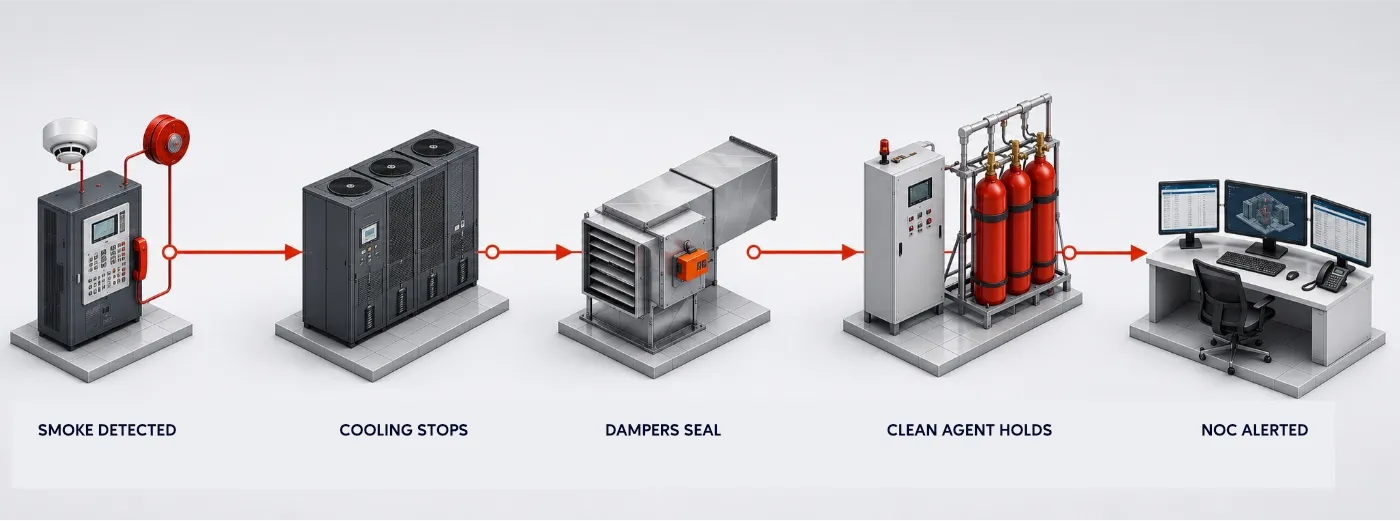
In a data centre, the systems are only as good as the points where they meet. A fire event has to stop the cooling, seal the room and hold the agent in the right order. None of that happens by accident. It happens because the interfaces were drawn at design stage and tested before handover.
One integrated response to a single event
Smoke detected at smouldering stage
Cooling units stop
Dampers and doors seal
Clean agent releases and holds
NOC display flags the zone
On-call team alerted
When one team designs and commissions all of it under a single contract, those interfaces are one team's responsibility. When each system is a separate contract, the gaps between them belong to no one, until the day they fail.
In a data centre
One integration partner
Single contract
Multiple specialist contractors
Separate contracts
Cross-system interfaces
fire→cooling stop, access→CCTV, BMS→power
Designed and tested by one team
Fall between contracts, surface at commissioning
Cause-and-effect evidence for inspection
One party presents it
Each contractor points to the next
TIA-942 and Tier handover pack
Assembled as one package
Fragmented, gaps found late
Working on a live floor
One coordinated change plan
Each crew schedules around its own work
After handover
One support contract across systems
Separate contracts, disputed faults
Compliance and authority requirements
The compliance we own, by system
Compliance is easier to judge when you can see it by system. Here is what each system we deliver is designed, tested and approved against, for data centre projects in India, the UAE and Oman.
The network the whole facility runs on
High-density structured cabling and the data backbone that carries every workload and every building system, designed for resilience and growth.
Authority approvalTest certification at handover
Designed, tested & certified to
TIA-568-D (2018)
Structured cabling design and performance
ISO/IEC 11801-5:2017
Cabling for data centre spaces
IEC 60364
Low-voltage electrical installations
Across all of them, you receive the evidence at handover: test certificates, the fire cause-and-effect matrix, the power and cooling commissioning records, and as-built drawings.
FAQs
Data centre systems: questions buyers ask us
The questions data centre owners, operations teams and consultants ask before they specify.
A data centre needs the physical infrastructure that the IT equipment runs on. That includes high-density structured cabling and the network, power and cooling controls (BMS), physical security and CCTV, and fire detection with clean-agent suppression. The servers, storage and DCIM software sit on top of this layer. We deliver the layer, not the compute or the applications.
With early detection and a clean agent that leaves no residue. Aspirating smoke detection catches a fault at the smouldering stage, before flame, and a clean-agent or inert-gas system to NFPA 2001 suppresses it without water near live racks. The release interlocks with cooling shutdown so the agent holds its concentration, and the whole sequence is proven in a cause-and-effect test.
Yes, the design targets the Tier or TIA-942 rating you set, and we build the evidence for it. Concurrent maintainability and redundancy are designed into the power and cooling paths, then proven at commissioning. Tier certification itself is awarded by the Uptime Institute, so we design and document to support that assessment rather than issue the certificate.
No, because the building systems sit on a network segmented from your IT. The BMS, access control and CCTV run on their own VLANs or a separate physical network, reaching production only through controlled gateways. This OT/IT separation means a cooling controller or a camera cannot become a path into your data.
Usually because scope has been left out, not because the price is better. Cheaper quotes often exclude integration testing, the cause-and-effect matrix, redundancy in the controls, spare containment capacity, or commissioning evidence. Those gaps surface at the worst time, during an audit or an outage. Ask for the exclusions in writing and compare scope line by line, not just the total.
Yes, with a phased method statement agreed with your operations team before any work starts. Cutovers are scheduled into change windows, every live path keeps a tested fallback, and no single point is disturbed without a backup in place. The aim is that the floor never loses a service it relies on while we expand or upgrade it.
Book a data centre infrastructure assessment
A clearer scope for your data centre, whether or not you work with us
Tell us about your data centre project and a senior engineer reviews it with you, then sets out what your systems need and where the risks are.
An engineer who has delivered data centre systems contacts you, not a salesperson
You get a response within one business day
No cost and no obligation for the assessment
If a single specialist contractor is the better fit, we will say so
Tell us about your data centre project
Response within one business day. No cost, no obligation.