

What integrated security systems include
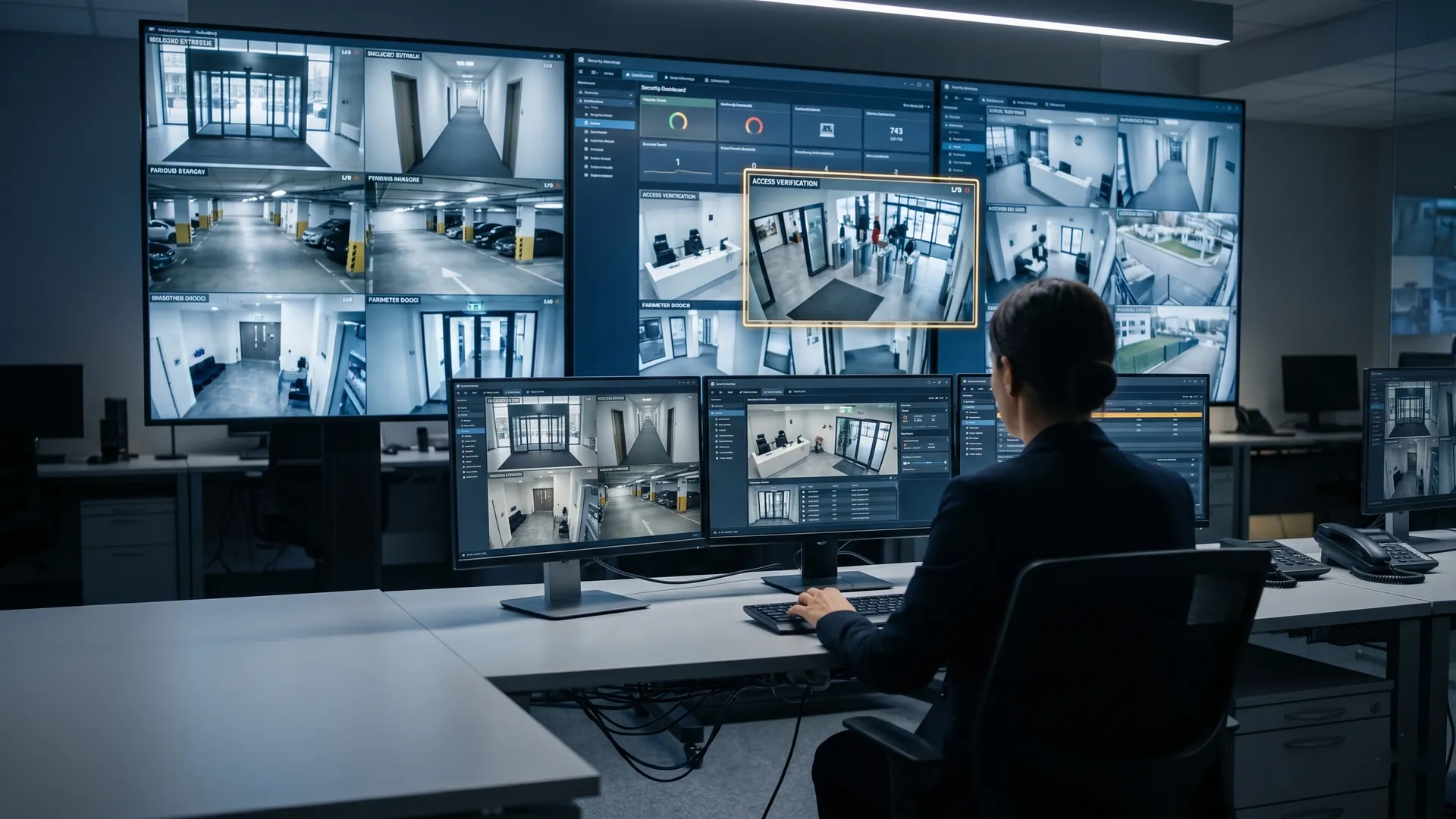
Integrated security systems are the practice of designing and wiring your video surveillance, access control and intruder detection to work as one platform, instead of three systems that never share an event. A complete integrated security scope covers IP CCTV and a video management system (VMS), access control and credentials, perimeter and internal intrusion detection, the event-correlation logic that ties them together, and all configuration and documentation from design through handover.
Site survey & risk design
Threat assessment, a camera coverage map, and a door-by-door access schedule.
IP CCTV & video management
IP cameras and a VMS, with storage sized to your required retention period.
Access control
Controllers, card, PIN or biometric readers, and the door hardware interface.
Intruder detection
Perimeter and internal sensors, panels, and zoned alarm response.
Integration & event correlation
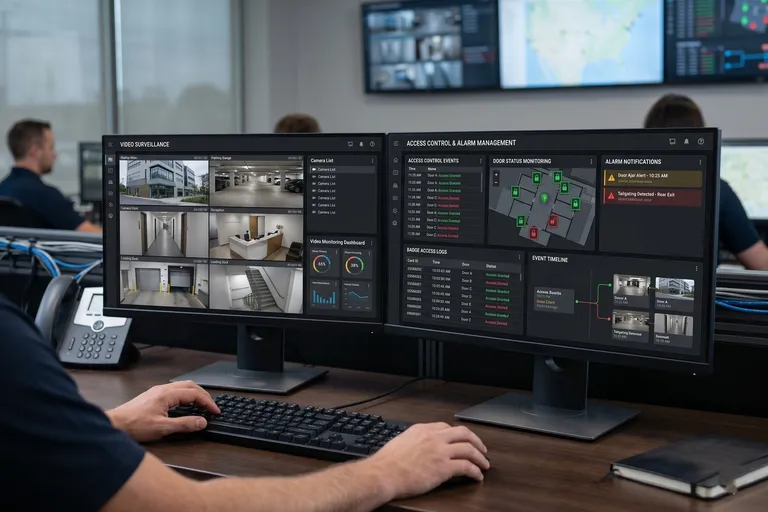
CCTV, access, intrusion and fire alarm linked so one event triggers the right response.
Handover documentation
As-built drawings, device schedule, coverage map, VMS backup, and operator training.
The coverage map, door schedule and integration matrix are agreed and approved before any device is ordered. Nothing is procured until the design is confirmed.
What goes wrong when security systems are installed separately
Four failures that appear after installation, not before. Each is preventable at design stage.
Technical specification
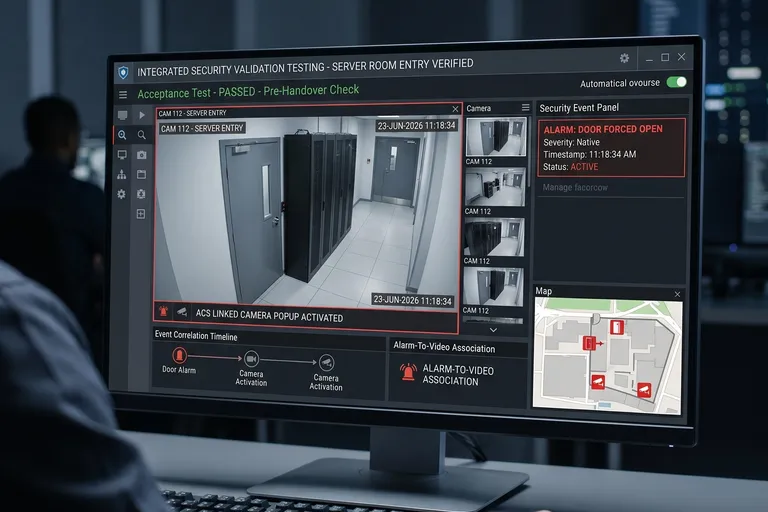
Integrated security systems at Yakkaservices use ONVIF-conformant hardware so cameras, recorders and door controllers from different manufacturers work together, with ISO/IEC 27001:2022 controls applied where your security devices share the corporate network. Cameras are selected by scene: resolution, lens and low-light performance are matched to each coverage zone, not bought as one model for the whole site. Recording storage is sized to your required retention period at full frame rate. Before handover, the cause-and-effect between your cameras, doors, alarms and the fire system is tested and witnessed, and the results are recorded in the handover package.
What affects the cost of an integrated security system
The cost of an integrated security system varies with camera count and type, the retention period your storage must hold, the number of controlled doors and the reader type, how deeply the systems are integrated, and whether a staffed control room is in scope. A site that needs 30-day footage retention and biometric access on every door costs far more per opening than one needing seven days and card readers, even at the same camera count.


Standalone, integrated or cloud: which security architecture fits your site?
The architecture you choose shapes how your security runs for the next 10 to 15 years. Buying three separate systems because each looked cheaper is the most common and most expensive decision to reverse once the building is occupied.
For a single site with a control room and doors on escape routes, an integrated platform is the more defensible choice: one audit trail, tested cause-and-effect, and no second uncoordinated scope added later. Standalone systems suit small sites with a few cameras and doors. Cloud or hybrid suits estates of many small sites where local IT is limited.
What security integration connects to in your building
Integrated security rarely stands alone. It rides on your cabling, shares decisions with life safety, and feeds events to the systems that run the building. Leaving these links out of scope creates coordination gaps during installation and finger-pointing after handover.
Structured cabling
Every IP camera, reader and controller runs on structured cabling with the right PoE budget. Specify security devices outside the cabling scope and a second, uncoordinated cabling job usually follows as a variation.
View structured cablingLife safety & fire alarm
Doors on escape routes must release on a fire signal. The cause-and-effect between the fire alarm and every access-controlled door is a design decision, not a site improvisation.
View life safety systemsBuilding management system
Access and alarm events can drive the building: lights and HVAC follow occupancy, and out-of-hours entry raises a BMS alarm. Decide which events cross over at design stage.
View BMS servicesAV & command centre
A control room needs a video wall, operator workstations and a public-address link so an event can trigger an announcement. The command-centre AV belongs in the integration design.
View AV solutionsFrequently asked questions
The questions buyers ask about integrated security systems before going to tender.
When we are not the right choice
We will tell you directly when your project is not the right fit. These are the three situations where you should look elsewhere.
Your site needs a few cameras and one or two doors
A local security installer will deliver a small standalone system faster and at a lower cost than we will. We focus on sites where security is integrated with other systems and run from a control room. If your project is small and standalone, we will say so at the first conversation.
Your tender is scored on lowest price only
If the scope leaves out the site survey, event-correlation commissioning, or cause-and-effect testing, we will not win that tender, and we will not strip those steps to match a lower number. A proposal without them is a different scope, not a cheaper one.
You want a consumer or single-brand cloud system you manage yourself
If you have chosen an off-the-shelf cloud camera kit and plan to self-install and self-manage, you do not need an integrator. We earn our place where systems must work together, satisfy a regulator, and hand over documented. For a plug-and-play setup, that is cost you do not need.
You're a good fit if…
Your project is a commercial building, hospital, bank, campus, warehouse or industrial site where security is part of a larger ELV or multi-system scope, where you need event correlation, a single audit trail, and doors that release correctly on a fire alarm, and where the system has to run reliably and stay auditable for 10 to 15 years.
A security scope you can test every proposal against
A security assessment gives you a coverage map, a door-by-door access schedule, and an indicative budget range for your specific site, so procurement compares proposals that cover the same work.
Tell us about your project
Response within one business day. No obligation.
Related resources
Extra Low Voltage (ELV) systems overview
How security integration fits into the full ELV scope: CCTV, access control, intercom and command-centre systems across your facility.
View ELV systemsHow much does an integrated security system cost?
A guide to the cost drivers, exclusions and budget ranges by site type and market.
Coming soon