
Guest Room Management · BMS Systems

Guest room management systems that lower energy cost per room and keep every room guest-ready

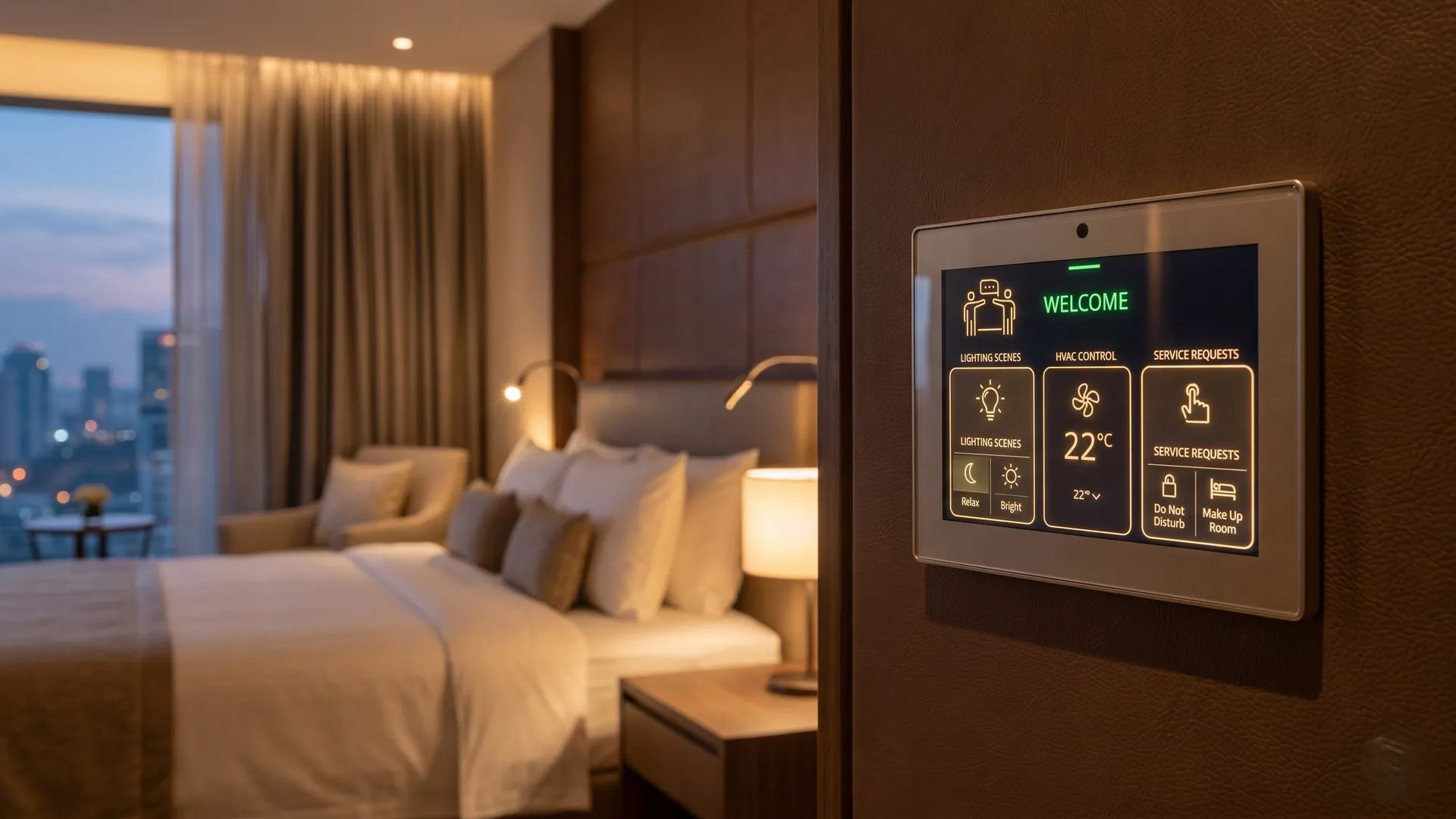
Guest room management system control panel in a hotel room
100%
of rooms function-tested and PMS-linked before you sign the handover certificate

Comfort the moment a guest walks in, energy savings the moment they leave.

You don't need another room full of switches. You need a guest room management system (GRMS) that makes a room comfortable the moment someone checks in, and stops an empty room from heating, cooling and lighting itself all day. This page covers in-room lighting, temperature, drape and service-request control, and the link to your property management system, across hotels, resorts and serviced apartments. You get rooms built on open protocols, BACnet (ANSI/ASHRAE Standard 135) and KNX, with every room function and the PMS link tested before handover.

PMS-integratedBACnet / KNX open protocolRoom-tested at handover
BMS systems overview
A building automation engineer replies within one business day, not a sales representative.
What it is

What a guest room management system includes

A guest room management system is the practice of designing, wiring and programming the controls in every room so the room responds to the guest and to your operation, instead of fitting standalone switches and a thermostat that never talk to each other. A complete GRMS scope covers the room-type survey and control schedule, the in-room panels and switches, and the lighting, temperature, drape and service-request control behind them. It also covers the occupancy and energy logic, the link to your property management system and door locks, and all programming, testing and documentation from design through handover.
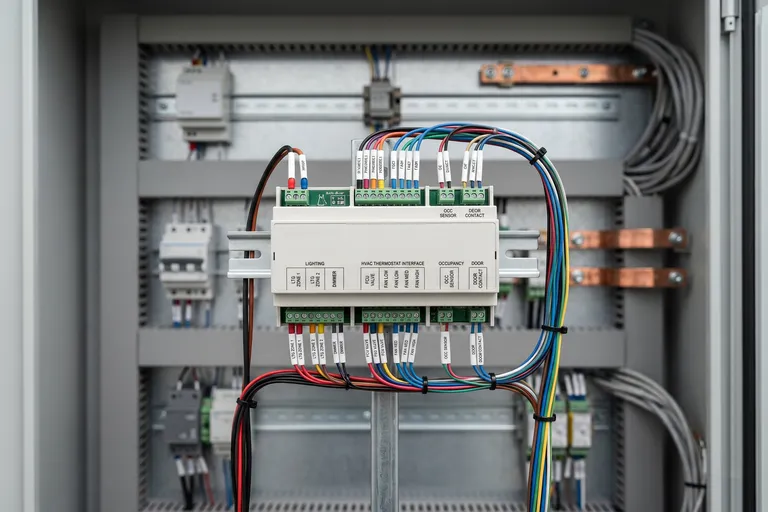
Open-protocol GRMS room controller on BACnet and KNX

Room survey & control schedule

Room types, control points per room and guest-experience logic mapped before any wiring is designed.

Guest room panels & interfaces

Bedside, desk and door panels, thermostats and switches sized to each room type, with app or voice control where specified.

Lighting & HVAC control

Scene-based lighting and fan-coil or thermostat control, so a room sets itself to the right level on entry.

Occupancy & energy logic

Keycard, door-contact and occupancy sensing that puts an unsold or empty room into setback automatically.

PMS, door lock & service requests

Check-in and check-out sync, do-not-disturb and make-up-room signalling, and housekeeping or service requests routed to your team.

Programming, testing & handover

Controller programming, room-by-room commissioning, editable as-built drawings and operator training.

The room types, control points and the property management system integration are agreed and approved before any controller or panel is ordered. Nothing is procured until the design is confirmed.

Risks

What goes wrong when rooms are wired instead of designed

Four failures that show up after the rooms are occupied, not before. Each one is preventable at design stage.

Risk 01

A PMS link that breaks the moment a guest checks in

When the GRMS and the property management system are integrated late, or only on paper, the room never learns it is sold. Energy setback stays off in empty rooms, and a checked-in guest walks into a room that was never woken. The link looks fine in a demo and fails at go-live under real occupancy. We have been called to hotels where the energy savings in the business case never appeared, because the property management system interface was never tested room by room.

Zero
energy savings, because the room never knew it was sold.
Prevention

Test the PMS integration against real check-in, check-out and room-move events, room by room, before handover, never as a single-room demo.

Specification

Technical specification

Guest room management systems at Yakkaservices run on open protocols, so your rooms are not tied to one manufacturer for the next 10 years. Each room has its own controller that drives the lighting, the fan-coil or thermostat and the drapes, and reads the door, the keycard holder and presence sensing to know whether the room is occupied. The controllers talk to your property management system, your electronic door locks and your building energy layer over a standards-based network. Before handover, every room function and the property management system link are tested room by room and recorded. The standards below are the baseline; your subject-matter expert confirms the controller and panel editions for your project.

Standards
BACnet (ANSI/ASHRAE Standard 135) and KNX (ISO/IEC 14543-3); controller and panel editions confirmed by the project engineer
Protocol & technology
Open-protocol room bus over BACnet, KNX or Modbus; wired control with wireless thermostats where a retrofit requires it
Room controllers & panels
One room controller per room; bedside, desk and door panels; dimmable lighting outputs; fan-coil or thermostat control
Occupancy & access
Door-contact, keycard or radio-frequency identification (RFID) holder, and presence sensing; do-not-disturb and make-up-room indication
Integration
Property management system (check-in, check-out, room move) · electronic door locks · BMS energy metering · fire alarm override
Testing method
Room-by-room functional commissioning; PMS interface tested against live check-in, check-out and room-move events; setback verified
Handover documentation
Editable as-built drawings · room control schedule · controller configuration backup · operator training
Network
Controllers run on segmented structured cabling; segmentation agreed with your IT team before any device comes online
Warranty
Extended manufacturer warranty on controllers and panels, activated at certified handover
Engineer commissioning guest room controls and the PMS link before handover
Room control schedule, commissioning test results and editable as-built drawings included as standard.
Cost factors

What affects the cost of a guest room management system

The cost of a guest room management system varies with the number of rooms and how many room types you run, and with the number of things you control in each room. It also depends on the panels and interfaces you choose, how deep the property management system and door-lock integration goes, and whether you are fitting out new rooms or working in an occupied hotel. A suite with motorized drapes, scene lighting and a touch panel costs far more per room than a standard room with a thermostat and a keycard, even on the same floor.

Hotel guest rooms of different types along a corridor
Number of rooms and room types

More rooms raise the hardware count; more distinct room types raise the design and programming effort.

Control points per room

Every added light circuit, drape, fan-coil zone and scene adds hardware and wiring per room.

Panels and guest interface

Designer or branded panels, touch screens and app or voice control cost more than standard switch plates.

Integration depth

The number of systems linked, and the certification effort with your PMS and door-lock vendors, drives the integration cost.

New-build or retrofit

An occupied hotel adds phased, out-of-hours work and may need wireless devices where rewiring is not practical.

Energy logic and metering

Presence sensing, per-room sub-metering and an energy dashboard add hardware and configuration beyond basic setback.

Standard exclusions(not included in a cabling quote)
Property management system and electronic door-lock licences or subscriptions
Interior design, joinery and panel face-plate finishes (where by others)
Active network switches and servers (where by others)
Civil and builder's work, conduit and back-boxes (where by others)
Guest-facing app development and content
Annual maintenance contract (AMC)
Process

How a guest room management system project is delivered

Every project follows five phases in sequence. No phase begins until the previous one is complete and documented. Nothing is procured until the design is approved. Nothing is handed over until every room has been tested.

01

Survey & control design

Your project starts with a survey of each room type. We map the control points, the guest-experience logic and the energy setback rules, and produce a room control schedule and an integration scope for your property management system and door locks.

No controller or panel ordered until the room control schedule and integration scope are approved.
02

Containment, cabling & power

Cabling, power and the room bus are installed to each room and device location to the design. Where controllers share the corporate network, segmentation is agreed with your IT team before any device comes online.

Cable routes, power and the room bus confirmed before any device is mounted.
03

Device installation

Room controllers, bedside and door panels, thermostats and sensors are installed and terminated to the schedule. Every device is set to its room and labelled at both ends to match the control schedule.

Every device labelled to the schedule before programming begins.
04

Programming, integration & commissioning

The controllers are programmed, the property management system and door-lock links are configured, and the occupancy and setback logic is set. The system is then commissioned room by room: each function is proven, the PMS link is tested against live check-in and check-out, and setback recovery is verified.

Every room function and the PMS link tested across every room before handover.
05

Handover & documentation

Handover is not signed until the editable as-built drawings, the room control schedule, the controller configuration backup, the commissioning record and operator training are produced, reviewed and accepted.

Not signed off until every document and the operator training are accepted.
Key comparison

Open protocol, proprietary or keycard-only: which GRMS fits your hotel?

The GRMS approach you choose shapes the guest experience, the energy savings you can actually tune, and what it costs to change suppliers years later. Picking a platform on the strength of a demo app, without weighing how locked-in it leaves you, is the most common reason a GRMS frustrates the operator who inherits it.

Compare options
Select a category
Room control scope
Energy only: lights off and setback on keycard removal
Full: lighting scenes, HVAC, drapes, service requests
Full, same scope
Guest experience
Basic
Scene control, do-not-disturb, make-up-room, service requests
Scene control, often a polished branded app
Integration
Limited
PMS, door locks, BMS and fire over open protocol
PMS and locks via the vendor; other links may be closed
Energy savings
Good for the price
Strong, tunable per room and room type
Strong
Lock-in
Low hardware, but no real platform to build on
Open: multi-vendor spares and upgrades
One supplier for every spare and upgrade
Upgrade at refurbishment
Limited; usually replaced
Competitive; mix vendors on the same bus
Premium variations through a single supplier
Best for
Budget properties with an energy-only goal
Most hotels wanting experience, savings and flexibility
Brand-mandated platforms and signature guest apps

For most hotels that want the guest experience, the energy savings and the freedom to change suppliers later, an open-protocol GRMS is the more defensible choice. A proprietary system makes sense when a brand standard mandates a specific platform, or when a signature guest app is part of the offer. A keycard-and-thermostat setup suits a budget property whose only goal is to stop empty rooms wasting energy.

Cross-service

What a guest room management system connects to in your building

Guest rooms rarely stand alone. They roll up to the building’s energy systems, share devices with your ELV scope, and follow the same control logic as the spaces around them. A fire alarm can also override the rooms, unlocking and lighting them on evacuation. Leave these links out of scope and you get coordination gaps during installation and finger-pointing after handover.

Building management system

Room energy data rolls up to the building BMS and dashboard, so you see consumption by floor and zone, not just per room.

View BMS services

Energy management & metering

Per-room setback only proves its worth when it is metered. Sub-metering and analytics turn room logic into a line on your energy report.

View energy management

Lighting control systems

Corridor, lobby and facade lighting follow the same control philosophy as the rooms, so the property behaves as one system, not many.

View lighting control

ELV: door locks, keycard & IPTV

The electronic door lock, keycard holder and in-room IPTV sit in your ELV scope and must be coordinated with the GRMS, or a second uncoordinated job follows as a variation.

View ELV systems
Relevant industriesHospitality & hotelsResortsServiced apartments
FAQs

Frequently asked questions

The questions hotel owners and engineering teams ask about guest room management systems before going to tender.

GRMS stands for guest room management system. It is the set of in-room controls, lighting, temperature, drapes and service requests, wired and programmed to work together and to follow your property management system. Think of it as the room's control panel and its brain, instead of a wall of separate switches. The point is a room that sets itself for the guest when sold and saves energy when empty.

Through a tested software interface between the GRMS and your PMS. When a room is sold, the PMS tells the room to come to a comfortable state; when the guest checks out, the room drops to energy setback. We test that link against live check-in, check-out and room-move events, room by room, before handover, because an untested interface is the most common reason the energy savings never appear.

Choose open protocol unless a brand standard requires otherwise. An open system on BACnet (ANSI/ASHRAE Standard 135) or KNX lets you mix vendors for spares and upgrades, so a refurbishment is a competitive choice rather than a forced buy. A proprietary system can be the right call when a hotel brand mandates a specific platform or a signature guest app. We install both and will tell you which fits your project.

Because rooms differ in how much they control and how they are built. A standard room with a thermostat and a keycard costs far less than a suite with scene lighting, motorized drapes and a touch panel. Retrofitting an occupied hotel adds out-of-hours work and sometimes wireless devices, and the depth of your PMS and door-lock integration moves the figure too. That is why we quote per room against your actual room types, not a single rate.

Yes, mainly by stopping empty rooms heating, cooling and lighting themselves. The saving depends on your climate, occupancy pattern and how the setback is tuned, so we will not quote one percentage we cannot stand behind for your property. We size the expected saving against your room types and metering during the assessment. The figure only holds if the setback is tuned so guests do not override it, which is part of commissioning.

Yes, when the system is designed to fail safe. Each room controller holds its own logic, so a network or server drop leaves the guest with local control of lights and temperature rather than a dead room. Door locks and life-safety functions run independently of the GRMS. We confirm this fail-safe behavior during commissioning, because a room that goes dark on a network blip is a design choice you can avoid.

Honest fit

When we are not the right choice

We will tell you directly when your project is not the right fit. These are the three situations where you should look elsewhere.

You have a handful of rooms in a small property

A local electrician or a packaged keycard-and-thermostat kit will fit out a few rooms faster and at a lower cost than we will. We focus on guest room management systems that integrate with the property management system, run across a whole property, and have to stay working and documented for years. If your project is a small guest house, we will say so at the first conversation.

Your tender is scored on lowest price only

If the scope leaves out the survey, the PMS integration testing or the room-by-room commissioning, we will not win that tender, and we will not strip those steps to match a lower number. A proposal without them is a different scope, not a cheaper one.

You only want empty-room energy savings, nothing else

If your single goal is to stop empty rooms wasting energy, a keycard-and-thermostat setup does that without a full GRMS, and you do not need an integrator to fit it. We earn our place where the rooms are networked, integrated with your PMS and door locks, and centrally managed. For an energy-only goal, that is cost you do not need.

You're a good fit if…

Your project is a hotel, resort or serviced-apartment property where the rooms are networked, integrated with the property management system and door locks, energy-managed per room, and have to run reliably and stay documented and serviceable for years.

Book a GRMS assessment

A GRMS scope you can test every proposal against

A guest room management assessment gives you a room control schedule, an energy and integration plan, and an indicative per-room budget range for your specific property, so procurement compares proposals that cover the same work.

A building automation engineer contacts you, not a sales representative
Response within one business day
Indicative room control schedule, integration plan and per-room budget range in writing within five business days of the site visit
No obligation. If we are not the right fit, we will tell you directly

Tell us about your project

Response within one business day. No obligation.