
Lighting control · Building management systems

Lighting control systems that cut lighting energy you can measure and stay easy to run after handover

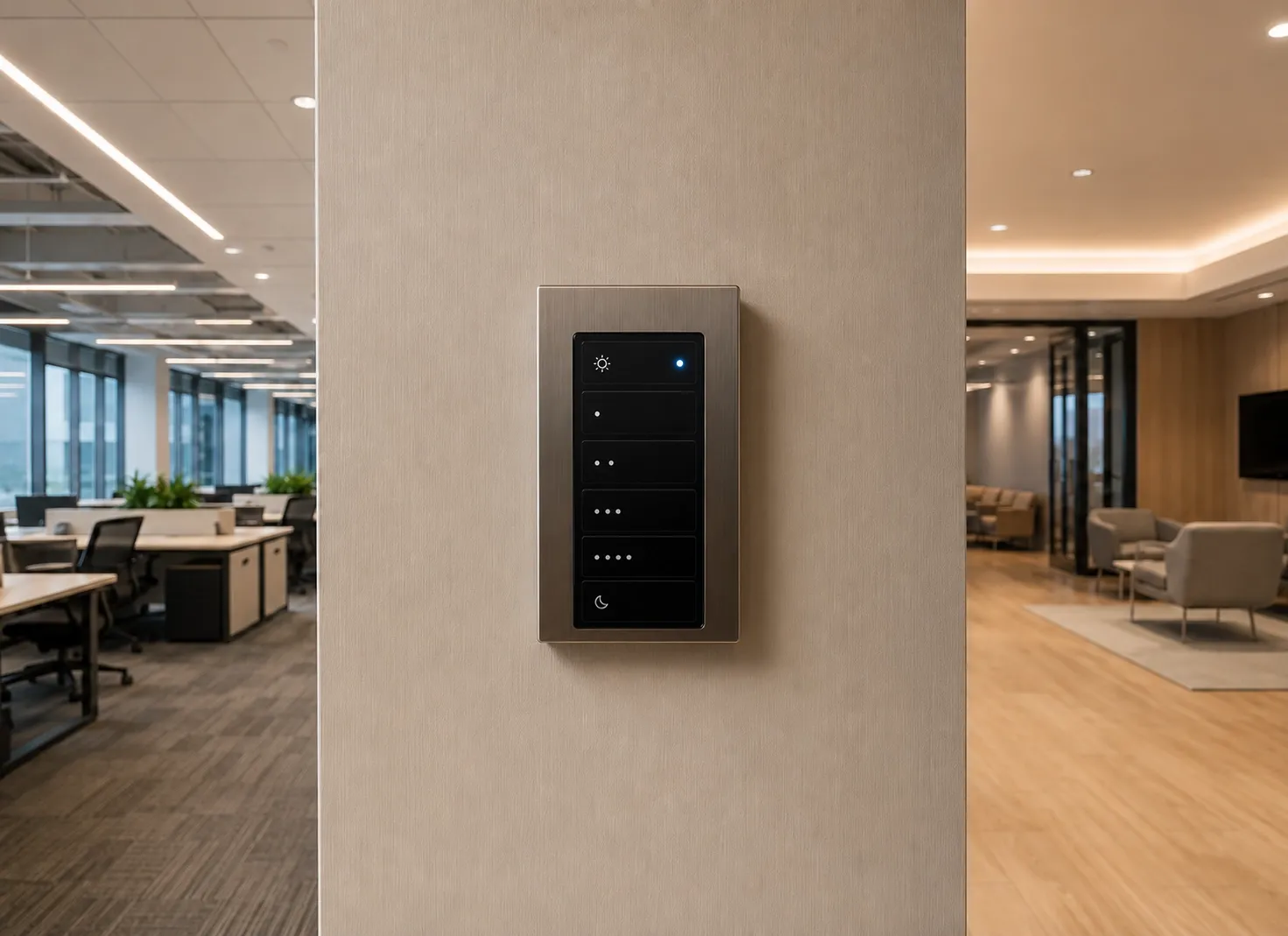
Lighting control system keypad in a daylit commercial office
100%
of zones commissioned and demonstrated before you sign the handover certificate

One control layer that switches, dims and schedules every luminaire from occupancy, daylight and time, and proves the saving on your meter.

You can switch a building's lights with a relay and a timer. What you cannot do that way is prove the saving, dim to daylight, or change a floor's schedule without a site visit. A lighting control system closes that gap. It addresses every luminaire, drives them from occupancy, daylight and time, and reports what each zone uses, so a saving shows on your meter instead of in a brochure. We design and integrate these systems on open DALI-2 and KNX, commissioned against a measured baseline, so your lights answer to you, not to one luminaire vendor.

DALI-2 (IEC 62386)KNX (ISO/IEC 14543-3)Zones commissioned at handover
Building management systems overview
A certified controls engineer replies within one business day, not a sales rep.
What it is

What a lighting control system includes

A lighting control system is the layer that decides when, where and how bright your lights run, and records what they use. It connects every luminaire, sensor and switch to a network of controllers and a central interface, then drives the lights from occupancy, daylight and schedule rather than a wall switch left on all day. People also call it an automated lighting control system or an intelligent lighting control system. A complete scope is more than sensors on a ceiling. It covers the control strategy, the zoning plan, the protocol and wiring, the sensors and keypads, the panels and gateways, the energy reporting, and the integration with your building management and emergency lighting, from the first survey through to a documented handover your facilities team can run on its own.

DALI lighting control panel with dimmer modules and gateway

Control protocol and topology

DALI-2, KNX or 0-10V, addressing each luminaire or zone so you can regroup spaces in software, not with a screwdriver.

Sensors and inputs

Occupancy and vacancy detectors, daylight photocells, and keypads, placed for the way each space is actually used.

Control strategies and scenes

Scheduling, daylight harvesting, occupancy switching and scene presets, set to your hours and tasks, not a default template.

Lighting control panels and gateways

Relay and dimmer panels and gateways that bring every fitting onto one network and onto your BMS.

Energy monitoring and reporting

Lighting circuits metered and reported by floor and zone, so a saving shows on the meter and not only in the design intent.

BMS and emergency lighting integration

Lighting tied to the building automation system, with emergency lighting tested and logged rather than left as a separate island.

The control strategy and the zoning plan are agreed and approved before any panel, sensor or driver is ordered. Nothing is procured until you confirm how each space should behave.

Risks

What goes wrong with lighting control systems

Four failures that show up after the lights are live. Each one is a design or commissioning decision, not bad luck, and each is preventable before a single sensor goes on the ceiling.

Risk 01

Sensors fitted, control strategy never commissioned

The detectors and dimmers go in, the system powers up, and the lights still behave as if they were on a manual switch, because no one tuned the time delays, the scenes or the daylight setpoints. The hardware is capable; the logic was never set. We have walked onto fitted floors where every sensor was live and every light still ran flat out from morning to night.

Lights on all day
capable hardware running an uncommissioned strategy saves nothing.
Prevention

Commission the control strategy zone by zone, time delays, daylight setpoints and scenes, and demonstrate each one to your team before handover.

Specification

Technical specification

Your lighting control system is designed to open standards, not to one manufacturer's ecosystem. Luminaires, sensors and gateways communicate over DALI-2, KNX and 0-10V, so fittings from different makers report to one platform and onto your BMS over BACnet. Control strategies follow the lighting provisions of ASHRAE 90.1 and the Energy Conservation Building Code, and emergency lighting is tested and logged to the relevant code. Every device is addressed and recorded, and before handover each zone is commissioned and demonstrated, so the strategy you signed off is the strategy that runs.
Standards
DALI-2 (IEC 62386) · KNX (ISO/IEC 14543-3, EN 50090) · ASHRAE 90.1 lighting controls · ECBC, IGBC and LEED lighting credits
Protocols
DALI-2 (IEC 62386) · KNX · 0-10V (IEC 60929) · DMX512 for architectural and facade lighting · BACnet (ANSI/ASHRAE Standard 135) and Modbus to the BMS
Field devices
Occupancy and vacancy detectors · daylight photocells · DALI drivers and dimmer modules · relay and dimmer panels · keypads and scene plates
Control strategies
Occupancy and vacancy switching · daylight harvesting · time scheduling · scene presets · manual override with automatic return
Emergency lighting
Maintained and non-maintained luminaires · automatic and self-test function to IEC 62034 · monthly and annual test logs (IS 9583 / EN 1838 where applicable)
System integration
Lighting reports to the BMS on its own network segment · lighting circuits metered · links to energy management and AV scene control
Handover documentation
As-built lighting zone drawings · addressing and configuration files · points list · commissioning and test records · operator guide
Warranty
Manufacturer warranty on drivers, sensors and panels; extended cover activated at certified, commissioned handover
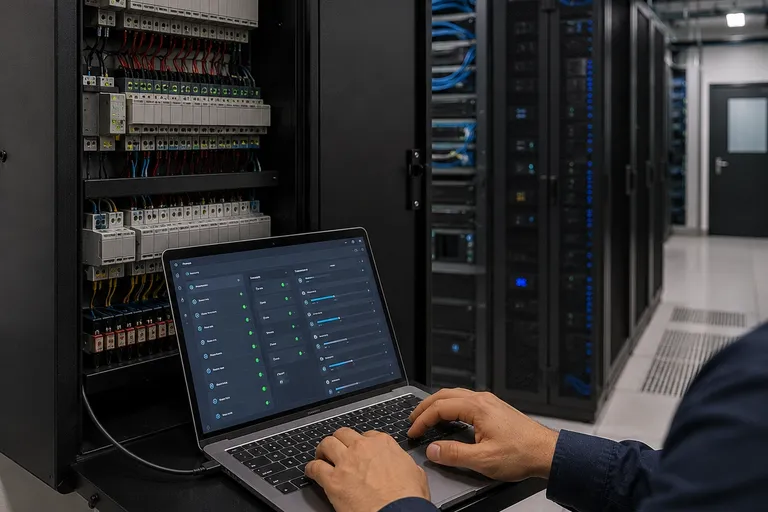
Engineer commissioning lighting control zones before handover
The as-built zone drawings, the addressing and configuration files, and the commissioning records are included as standard, in formats your team owns.
Cost factors

What affects the cost of a lighting control system

The cost of a lighting control system moves with the number of control points, how fine the zoning is, the protocol you choose, the number and type of sensors, how much it integrates with other systems, and whether it is retrofitted into a live building or designed in from the start. We publish the drivers, not a price, because a real figure comes from your control strategy and your building, not a rate card.

Addressable luminaires across an office ceiling, each a lighting control point
Control point count

Every addressable luminaire, driver and circuit adds hardware, addressing and configuration. The number of points is the single biggest driver.

Zoning granularity

Controlling by desk or fixture costs more than by room or floor, and gives you finer control and a deeper saving.

Protocol choice

Fully addressable DALI-2 or KNX costs more than switched or 0-10V zones, and does far more with the same fittings.

Sensor count and type

Occupancy, daylight and dual-technology detectors add devices and commissioning time; how many you need depends on the space.

Integration depth

Tying lighting into an existing BMS, energy metering or AV scene control adds interfacing and testing time.

Retrofit or new build

Fitting controls and wiring into a live, occupied building costs more than control designed in from the start.

Standard exclusions(not included in a lighting control quote)
Luminaires and lamps themselves, unless quoted as a separate supply package
Power wiring, containment and builder's work by the electrical contractor
Modifications to live distribution boards and circuits by others
ICT network and internet links beyond the lighting control segment
Software or cloud licences beyond the initial term
Facade and architectural feature lighting design by a specialist where required
Annual maintenance contract (AMC)
Process

How a lighting control project is delivered

Every project runs in five phases. No phase starts until the previous one is complete and documented.

01

Survey and control strategy

Your project starts with a survey of how each space is used and a control strategy: which zones, which sensors, and how the lights should behave at each time of day. From that comes a zoning plan, a points list and an addressing schedule you review before anything is bought.

No hardware is ordered until the control strategy and the zoning plan are approved.
02

Procurement and configuration

Panels, drivers, sensors and gateways are procured to the schedule and configured off site where possible, with scenes and groups built to your strategy ahead of site work.

Addressing schedule and scene structure reviewed before any site work begins.
03

Installation and addressing

Panels, drivers and sensors are installed at the agreed positions, wired onto the control network, and each device is addressed, labelled and recorded.

No device left unaddressed, unlabelled or off the network at the end of any day.
04

Commissioning and demonstration

Time delays, daylight setpoints and scenes are tuned zone by zone, the lighting baseline is recorded before tuning, and each zone is demonstrated to your team so the behaviour matches what you signed off.

Every zone commissioned and the baseline recorded before handover is offered.
05

Handover and documentation

Handover is not signed until the as-built zone drawings, the addressing and configuration files, the commissioning and test records, and operator training are produced and accepted by your team.

Not signed off until every document is accepted and your team can run the system.
Key comparison

Wired DALI, wireless mesh or standalone controls: which is right for your building?

The control topology you choose decides how much of the building you can change in software, where the saving actually comes from, and what it costs to run for the next 15 years. Picking it from the lighting layout alone, rather than how the spaces will be used and re-used, is the most common and most expensive mistake on a controls project.

Compare options
Select a category
Addressability
Every luminaire, individually
Every node, individually
Per room or zone only
Main saving source
Daylight, occupancy and scene, building-wide
Occupancy and scene, retrofit-friendly
Occupancy, room by room
Re-zoning
In software, no rewiring
In software
Limited, set at the unit
Control wiring
Control pair to each fitting
Minimal, mains or battery nodes
Local wiring only
Retrofit into an occupied building
Disruptive where new wiring is needed
Low disruption
Low disruption
Best for
New build and major refurbishment, fine control
Retrofit, heritage and hard-to-wire spaces
Small or simple spaces, single rooms

For a new building or a major refurbishment where you want building-wide daylight and occupancy control that you can re-zone in software, wired DALI-2 or KNX is the more defensible choice. Wireless mesh earns its place in retrofits and heritage buildings where new control wiring is disruptive or impossible. Standalone room controllers are appropriate for small or simple spaces where each room only needs to switch on occupancy and nothing has to talk to anything else.

Cross-service

What other building systems your lighting control connects to

Your lighting control system rarely runs alone. It shares occupancy and daylight data with other systems, reports over the same network, and is one of the largest controllable loads in the building. These are the connections that belong in the design from the start, not bolted on after handover.

Building management system

When lighting reports to the BMS over BACnet (ANSI/ASHRAE Standard 135), occupancy and schedule are shared with HVAC, and your team runs one interface instead of two. Left on its own island, that data never crosses, and every change has to be made twice.

View BMS services

Energy management and metering

A control strategy only proves itself on the meter. Metering the lighting load and tying it to your energy management system turns a design promise into a number you can show your finance team. Without that link, you have control but no evidence of the saving.

View energy management

Building automation and HVAC

Occupancy is the most valuable signal in the building, and your lighting sensors capture it in every space. Shared with building automation, the same presence data that dims an empty corridor can set back HVAC in an unoccupied zone. Designed together, the two systems use one set of sensors instead of two.

View building automation

Structured cabling and the control network

Your controllers, gateways and sensors report over a network. The lighting control segment is designed alongside the structured cabling, on its own segment, so it is not competing with corporate traffic or pulled in later as a variation order after the ceiling is closed.

View structured cabling
Relevant industriesHospitalityHealthcareData centresCampuses
FAQs

Frequently asked questions

The questions buyers ask about lighting control systems before they specify a project.

It can, and lighting is one of the easiest building loads to cut, but the saving comes from the control strategy, not the hardware. The system reduces energy by switching lights off in empty spaces, dimming to available daylight, and running to your real hours instead of all day. Those savings only appear if the strategy is commissioned and someone owns it after handover. We meter the lighting load and record a baseline before tuning, so the reduction is measured on your bill, not estimated in a brochure.

DALI-2 (IEC 62386) addresses each luminaire and is built specifically for lighting, so it is the usual choice where you want fine dimming and control fitting by fitting. KNX (ISO/IEC 14543-3) is a building-wide control bus that handles lighting alongside blinds, HVAC and scenes, so it suits projects integrating more than lighting alone. Many buildings use both: DALI within each space, KNX across the building. We specify based on how much you want to control and integrate, not on a single preferred brand.

Often you can add it, depending on what you already run. We survey your current BMS, its protocol and its spare capacity first. Where the building management system speaks an open protocol like BACnet, we bring lighting onto it rather than installing a parallel system. Where the existing system is closed or undocumented, we show you the honest comparison between extending it and starting clean before you spend.

It depends on how your spaces are used. Scheduling alone suits areas with predictable hours, such as a reception that runs nine to six. Occupancy sensing earns its place in spaces used unpredictably, like meeting rooms, washrooms and stores, and daylight sensing pays back wherever there is glass and perimeter lighting. We set the mix space by space during the survey, so you pay for the sensors that return a saving, not for sensors watching a room that is always full.

Not when the system is designed on open protocols. DALI-2 and KNX are multi-vendor standards, so you can buy compliant drivers, sensors and luminaires from more than one maker and add to the system later. We hand over the addressing and configuration files as named deliverables, so any competent controls contractor can maintain or extend it. If a proposal ties you to one brand’s closed ecosystem, that is a commercial choice, not a technical requirement, and we will tell you so.

The cost depends on the number of control points, how fine the zoning is, the protocol, the number and type of sensors, and whether it is a retrofit or designed in from the start. A floor that controls every luminaire on DALI with daylight and occupancy sensing costs more than switched zones on a timer, and does far more. We do not publish a rate card, because a real figure comes from your control strategy and your building, not an average. Book a lighting control assessment and you get an indicative budget range for your building in writing.

Honest fit

When we are not the right choice

We will tell you directly when your project is not the right fit.

Your tender is evaluated on lowest price only

We will not strip out the commissioning, the lighting metering, or the sensor coverage to match a cheaper number. Those are the parts that make the system save energy and stay usable, so a proposal that leaves them out is not a cheaper version of the same scope. It is a different scope, and it is the one that ends up as lights running flat out after handover.

You need a few rooms or a small office controlled

For a small space on a handful of circuits, off-the-shelf smart switches or standalone occupancy sensors will give you most of the benefit at a fraction of the cost. A full addressable lighting control system is more than that space requires. We focus on buildings where lighting is one zone of a larger control and integration scope, and we will say so at the first conversation.

No one will own the control strategy after handover

A lighting control system saves energy when someone acts on it, by keeping schedules, setpoints and scenes tuned as the building changes. If no one on your side will own that, the strategy drifts, occupants override it, and the saving fades within a year. We will raise this before you invest rather than after, because the hardware alone does not protect the return.

You're a good fit if…

Your project is a commercial building, hotel, hospital, data centre or campus where lighting control is part of a larger BMS or multi-system scope, where you want a measured energy saving, open multi-vendor protocols, and control your own team can run and extend reliably for the next 15 years.

Book a lighting control assessment

A control strategy to test lighting proposals against before you tender

A lighting control assessment gives you a draft control strategy, a zoning outline, and an indicative budget range for your building, so procurement compares proposals that cover the same work.

A certified controls engineer contacts you, not a sales representative
Response within one business day
An indicative control-strategy outline and budget range in writing within five business days of the site visit
No obligation. If we are not the right fit, we will tell you directly

Tell us about your project

Response within one business day. No obligation.