The systems that keep a telecommunication facility online secured, cooled and inspection-ready
When power drops at an exchange, an equipment room runs hot, or an unmanned tower site is breached at night, you do not lose convenience. You lose uptime, and sometimes the site itself. Yakkaservices designs, integrates, tests and supports the building systems behind your telecommunication estate under one contract: the network, physical security, environmental control, and clean-agent fire protection for your equipment rooms to NFPA 2001 (2022). You get one team accountable for how they work together, and for the certificates your fire and safety inspector asks to see.
What we sell, and when we are not your best option
Yakkaservices integrates the building and safety systems behind a telecommunication facility. Here is where that work fits, and where it does not.
When we are the right fit
When a site or an estate needs several systems designed, integrated, and certified together, and when one team is accountable for how they work as a whole.
When a single-system specialist fits better
If you need to replace one system on its own, a single CCTV run or one fire panel, a focused specialist contractor will often do it faster. That is the right call, and we will tell you when it is.
When you want an active-network or NMS vendor
If you are buying transmission and switching equipment, base-station radios, or a network management platform that runs your traffic, that is your active network, and you want a telecommunication equipment vendor or systems house. We design the cabling, security, environment and fire systems that sit around that equipment, not the equipment that carries your calls and data.
Why telecommunication is different
What makes a telecommunication facility's building systems different
Downtime is measured in minutes, and in penalties
Your network runs every hour of every day. When a power feed trips, a room overheats, or a link fails, the service behind it degrades, and the cost shows up as lost availability and, on many contracts, service-level penalties. Your building systems carry that load quietly, which is why a fault is easy to miss until customers feel it.
An equipment room is not an office, and water is not an option
A room full of switching and transmission gear runs hot, packs power into a small space, and cannot be put out with a sprinkler without ruining what it protects. It needs early smoke detection, clean-agent suppression that leaves no residue, and cooling that holds temperature and humidity in a tight band, around the clock.
Many of your sites have no one on them
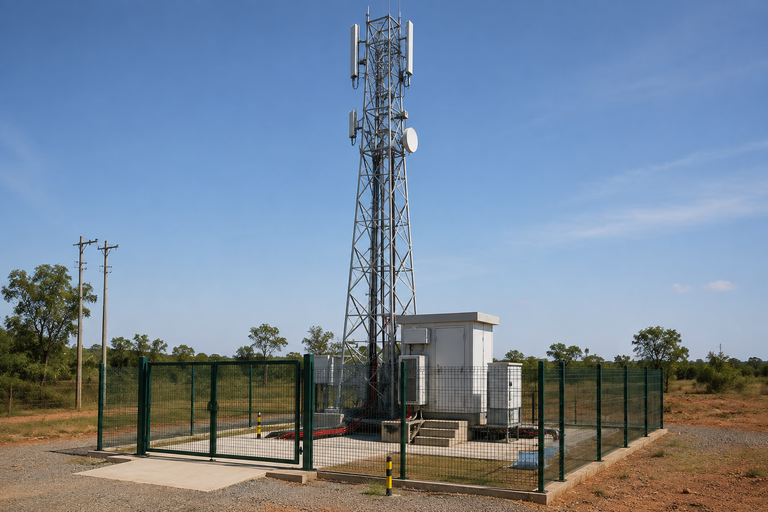
Exchanges are staffed. Tower and base-station sites usually are not. A cut fence, a stolen battery bank, a siphoned diesel tank, or an open door at 3am has to reach the right person live, because there is no one on site to notice. That only works when access control, CCTV, intrusion and environmental sensors report to one platform, not five that were installed separately.
Critical systems
The systems that keep a telecommunication facility running
Every exchange, tower site and operations room in your estate rides on the same physical infrastructure. We design, integrate and certify these six systems so they work together as one connected facility, not just alongside each other.
Structured cabling & the site network
Every system on a telecommunication site rides the same cabling: management data, CCTV, access control, and the links between your equipment rooms. We design and certify the copper and fibre to TIA-568-D (2018) and ISO/IEC 11801:2017, run for the heat and distance of a real site, with the resilience that keeps monitoring and security online when a switch or a link fails.
An exchange has server halls, battery rooms and a cable vault that each need a different rule about who gets in. Access control and CCTV let you set those rules by room, role and shift, log every entry, and watch the perimeter and gates. For unmanned tower sites, after-hours lock-down and tamper logic is designed in, not added after a theft.
Beyond the camera, a site needs to know when a fence is cut, a cabinet is opened, a room overheats, or a battery bank floods. Intrusion, door-tamper and environmental sensors feed the same platform, so an alarm reaches the right engineer on the right device, and a hot room or a leak is caught before it takes the site down.
Equipment rooms fail when they run hot, and they run hot the moment cooling drifts. The building management system controls precision cooling, ventilation and power, holds temperature and humidity in band, and shows you the trend by room. Built on BACnet and Modbus, and reported to ISO 50001 so energy is measured, not assumed.
A fire in an equipment room spreads through cable and plastic, and water would finish the job the fire started. Very early smoke detection triggers alarm and clean-agent suppression to NFPA 2001 (2022) and NFPA 72 (2022), sized to flood the room and leave no residue on your equipment, with the commissioning evidence the fire authority asks for.
Your operations team watches the whole estate from one room. We build the operations centre it works in: the video wall, the console and KVM layout, structured cabling to every position, and the briefing and meeting-room AV around it, so alarms from every site land in front of the people who act on them.
Where telecommunication site systems go wrong, and how the failure is prevented
Four failures that appear at commissioning or after handover. Each one is preventable at design stage.
01Failure 01
Fire suppression tested in isolation, not with the room
The detection passes on its own, the clean-agent cylinders pass on their own, and nobody runs them together with the room dampers and door releases until the fire authority does. On a telecommunication site that means a failed fire NOC on cause-and-effect, and an energisation date that slips while you re-test. We have been called to sites where the alarm sounded but the ventilation kept feeding the room and the agent would have vented straight out.
Consequence
A failed fire NOC inspection, and a go-live date that slips while you re-test.
Prevention
A written cause-and-effect matrix agreed early, then a full integrated test of detection, agent release, dampers and doors before the authority visits, not during it.
02Failure 02
Cooling shown as a number, not as a warning
A building management system that shows one room temperature tells you it is warm now, not that a cooling unit is drifting toward an alarm you could have prevented. In a packed equipment room, the gap between comfortable and thermal shutdown is short, and a total on a screen does not close it.
Consequence
A thermal shutdown that takes equipment, and the service on it, offline.
Prevention
Per-room temperature and humidity trends with alarms on rate of change, so a drifting cooling unit raises a warning while you still have time to act.
03Failure 03
Unmanned sites that record but do not alert
Cameras and readers on a tower site log everything and alert no one, so a cut fence, a stolen battery bank or a siphoned diesel tank is only found on the next site visit. By then the site may already be down, and the playback only tells you when it happened.
Consequence
A theft or an outage found on the next site visit, not the moment it happened.
Prevention
Design the alarm and escalation rules first, so a breach or a power fault at any site reaches the right person live, then commission against real response targets.
04Failure 04
Work that takes a live site offline
Cutting over a network, or pulling new containment through a working exchange without a phasing plan, drops service at the wrong time. The result is an outage you booked yourself, and a team working around your contractor instead of running the network.
Consequence
A self-inflicted outage, and staff working around a contractor instead of running the network.
Prevention
A phased plan agreed with your operations team, cutovers scheduled into maintenance windows, and a tested fallback for anything the live service depends on.
Integration
How the systems connect on a telecommunication site, and why that is the hard part
On a telecommunication site, the systems are only as good as the points where they meet. None of that happens by accident. It happens because the interfaces were drawn at design stage and tested before handover.
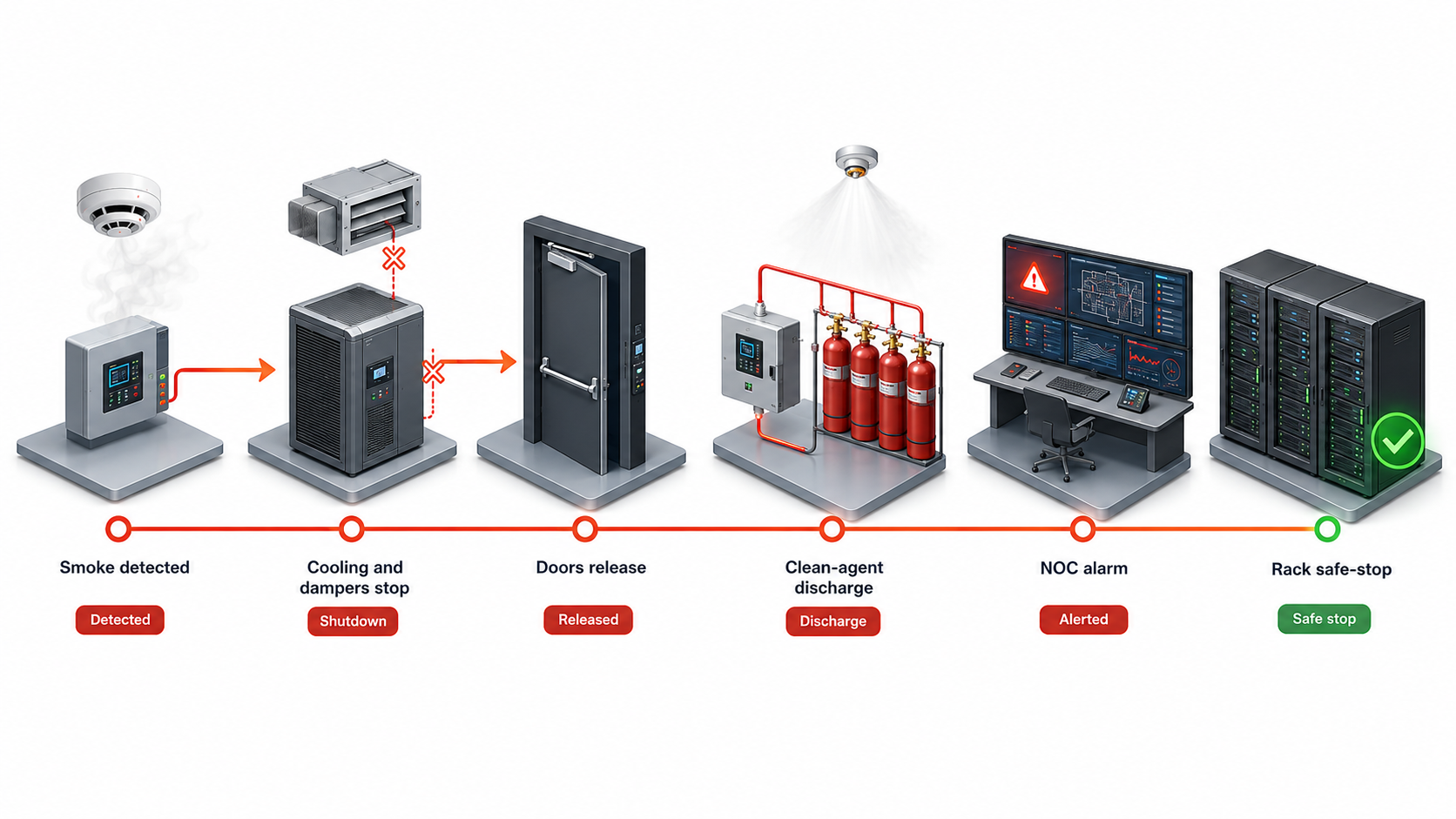
One integrated response to a single event
Smoke detected in the room
Cooling and dampers shut down
Access doors release
Clean agent discharges
Alarm reaches the NOC
Affected racks get a safe signal
When one team designs and commissions all of it under a single contract, those interfaces are one team's responsibility. When each system is a separate contract, the gaps between them belong to no one, until the day they fail.
Compliance is easier to judge when you can see it by system. Here is what each system we deliver is designed, tested and approved against. Every tab carries authority approval and test certification at handover.
The network everything else runs on
Structured cabling and the data backbone that carries every system on the site, designed for a telecommunication environment and for growth.
Authority approvalTest certification at handover
Designed, tested & certified to
TIA-568-D (2018)
Structured cabling design and performance
ISO/IEC 11801:2017
Generic cabling for customer premises
IEC 60364
Low-voltage electrical installations
Network and structured cabling
Across all of them, you receive the evidence at handover: test certificates, the fire cause-and-effect matrix, environmental monitoring verified against design, and as-built drawings.
FAQs
Telecommunication site systems: questions buyers ask us
The questions network owners, project teams, and consultants ask before they specify.
A telecommunication facility needs the physical infrastructure its equipment, people and safety case depend on. That means structured cabling and the site network, access control and CCTV, intrusion and environmental detection, building management for cooling and power, and very early smoke detection with clean-agent suppression. Your transmission, switching and radio equipment sits on top of this layer. We deliver the layer, not the active network that carries your traffic.
Water and energised electronics do not mix, so a sprinkler discharge over live equipment often destroys more than the fire would have. An equipment room is protected instead with very early smoke detection and a clean agent to NFPA 2001 (2022), which floods the room, starves the fire of oxygen or heat, and leaves no residue on your gear. A sprinkler or pre-action system still has a role for the structure around the room, and we design the two to work together rather than against each other.
They act on shared logic that is designed and tested before handover. When very early detection finds smoke, the system stops the cooling and closes the dampers so the agent is not vented away, releases the doors on the egress path, discharges the clean agent into the affected room, and raises the alarm at your network operations centre. Affected racks can receive a safe signal at the same time. The interfaces are written into a cause-and-effect matrix and proven in an integrated test, not assumed.
By making every site report to one platform with live escalation. Access control and door-tamper detection, perimeter intrusion, CCTV, and environmental and power sensors all feed the same head end, so a cut fence, a stolen battery bank, a siphoned diesel tank or a cooling fault reaches the right engineer on the right device the moment it happens. The rules are commissioned against real response targets, so an alarm at a remote site is acted on, not just recorded.
Yes. The systems are designed and documented to NFPA 72 (2022), NFPA 2001 (2022), NFPA 76 (2020) and the local fire authority's requirements. Inspection looks for evidence that detection and suppression were tested and commissioned together, so we hand over the cause-and-effect records, test certificates and as-built drawings the authority asks for. Final approval also depends on your building and room design, which sits outside the systems scope.
Yes, with a phasing plan agreed with your operations team before any work starts. Cutovers are scheduled into maintenance windows, anything the live service depends on keeps a tested fallback, and the method statement is built around your safety rules. The aim is that the network never loses a system it relies on at the moment it needs it.
Book a telecommunication facility assessment
A clearer scope for your telecommunication site, whether or not you work with us
Tell us about your telecommunication project and a senior engineer reviews it with you, then sets out what your systems need and where the risks are.
An engineer who has delivered telecommunication site systems contacts you, not a salesperson
You get a response within one business day
No cost and no obligation for the assessment
If a single specialist contractor is the better fit, we will say so
Tell us about your telecommunication project
Response within one business day. No cost, no obligation.
Telecommunication infrastructure solutions in India | Yakkaservices