Smart campus solutions that keep students safe and every building connected
You run an education estate where thousands of students depend on the network for every class, sit online exams that cannot fail, and trust your buildings to get them out safely. Smart campus solutions tie those systems together: your network, access control, CCTV, public address, ventilation and fire detection. Yakkaservices designs, integrates, tests and supports all of them under one contract, certified to standards like NFPA 72 (2022) and the National Building Code, so your school or university runs as one safe, connected estate.
What we sell, and when we are not your best option
Yakkaservices integrates the building systems behind a school or university. Here is where that work fits, and where another route serves you better.
When we are the right fit
When your institution needs several systems designed, integrated and certified together, and you want one team accountable for how the network, access control, CCTV, fire detection and public address work as a whole.
When a single specialist fits better
If you only need to replace one system on one building, a single CCTV run or one fire panel, a focused specialist contractor will often do it faster and for less. That is the right call, and we will tell you so.
When you want a software vendor
If you are buying a student information system, a learning platform, or admissions and timetabling software, that is education software. We design the network and physical systems those platforms depend on, not the applications themselves.
Why education is different
What makes education building systems different
Schools and universities never really empty
Term runs from early classes to evening lectures, with boarding houses, labs, libraries and sports halls in use long after the last bell. Many of the people on site are children. Your building systems carry a duty of care an office never has: who is on site, which doors are open, and whether help can reach a remote block at night. When one system fails quietly, you find out at the worst moment.
Demand spikes you can predict but cannot fail
Your network sits near idle for weeks, then every student logs in for an online exam, results day, or admissions at the same hour. Access gates see the same surge between classes. These peaks sit in your calendar months ahead, so a system that copes with an average day and buckles on exam morning is a design failure, not bad luck.
One estate, many buildings, one safety plan
An education estate is rarely one building. It is blocks, hostels, labs and halls spread across your site, sharing one network backbone and one fire and evacuation strategy. Moving thousands of students out safely, or locking a site down in an intruder event, only works when access control, fire detection and public address act as one system across every building, not building by building.
Critical systems
The systems that keep a school or university running
Every service your students and staff rely on rides on the same physical infrastructure. We design, integrate and certify these six systems so they work together, not just alongside each other.
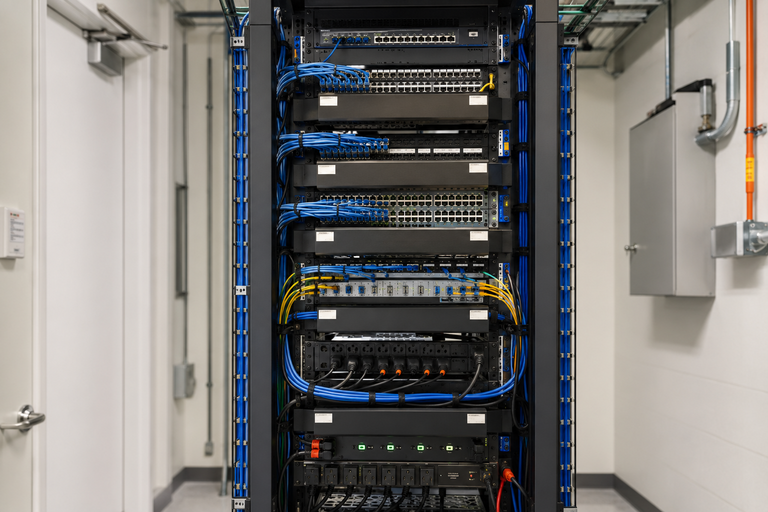
Campus network & structured cabling
Every digital service in your institution runs on this network: the virtual learning environment, online exams, the library and the WiFi in every lecture hall and classroom. We design and certify the cabling to TIA-568-D (2018) and ISO/IEC 11801:2017, sized for exam-day peak load, with the resilience that keeps a building online when a switch or link fails.
Who is allowed where, and when, changes by the hour on a school site: students, staff, contractors, parents and exam invigilators. Access control and visitor management let you set those rules by building, role and time, keep a record of who is on site, and lock down a zone in seconds. Safeguarding logic is designed in, not added after an incident.
Open sites, blind corners, sports grounds and car parks all need coverage that holds up when you review an incident weeks later. We design camera placement from a site survey and size storage for your actual retention period, so footage is there, clear and usable when a parent, the police or an insurer asks for it.
A large estate carries a large energy bill: heating and cooling across blocks, labs that need fresh air, halls that sit empty half the week. The building management system controls all of it and shows where the money goes, holding classrooms to the air quality ASHRAE 62.1 expects. Built on BACnet, Modbus and KNX, so you are not locked to one vendor.
Evacuating a school means moving large numbers of children quickly, calmly and by a route they have practised. Your addressable fire alarm triggers the right doors, signs and public address in sequence, to NFPA 72 (2022) and EN 54, with the commissioning evidence the fire authority asks for before it issues a no-objection certificate.
The same speakers can ring the class-change bell, carry an announcement, and deliver a clear evacuation message when it matters. We integrate public address and voice alarm so a fire event overrides routine paging by zone, and bring lecture-hall, auditorium and digital signage AV into the same scope for teaching and events.
Where education systems go wrong, and how the failure is prevented
Four failures that show up at commissioning or after handover. Each one is preventable at design stage.
01Failure 01
Fire systems tested in isolation, not together
The fire alarm passes on its own, the smoke control passes on its own, and nobody runs them together until the authority does. On a school that means a failed inspection on cause-and-effect, and a term start that slips while you re-test. We have been called to sites where the alarm sounded but the doors it should release never moved.
Consequence
A failed fire authority inspection, and a term start that slips while you re-test.
Prevention
A written cause-and-effect matrix agreed early, then a full integrated test before the authority visits, not during it.
02Failure 02
A network sized for an average day, not exam morning
The network runs fine all term, then every student loads an online exam or results page in the same ten minutes and it falls over. The system was sized for average use, not the peak you can see coming in your calendar. We have seen WiFi designed for browsing collapse the first time a whole year group sat an assessment on it.
Consequence
Online exams or results day fail in front of every student and parent at once.
Prevention
Design for peak concurrent load, not average, then load-test the network and WiFi against a real exam scenario before you rely on it.
03Failure 03
Access control and CCTV with gaps no one notices until later
A door is propped for convenience, a camera points at a wall, visitors sign a paper book no one checks. None of it matters until the day you need to prove who was on site or review what happened. On a school that is a safeguarding gap, and the footage you need is missing, dark or already overwritten.
Consequence
A safeguarding or intruder incident you cannot review, because the coverage or the records were not there.
Prevention
Design coverage and visitor management from a site survey, set retention to your real requirement, and commission door and camera positions against it, not on paper.
04Failure 04
Installation that disrupts a live term
Cutting over a network or running new containment through occupied buildings without a phasing plan takes classrooms offline at the wrong time. The consequence is cancelled lessons, disrupted exams, and staff working around your contractor instead of teaching. We have seen cutovers booked for the one week a school could least afford.
Consequence
Cancelled lessons and disrupted exams, with staff working around a contractor instead of teaching.
Prevention
A phased plan agreed with your estates and academic teams, cutovers scheduled into holidays and low-activity windows, and a tested fallback before anything is switched.
Integration
How the systems connect on a campus, and why that is the hard part
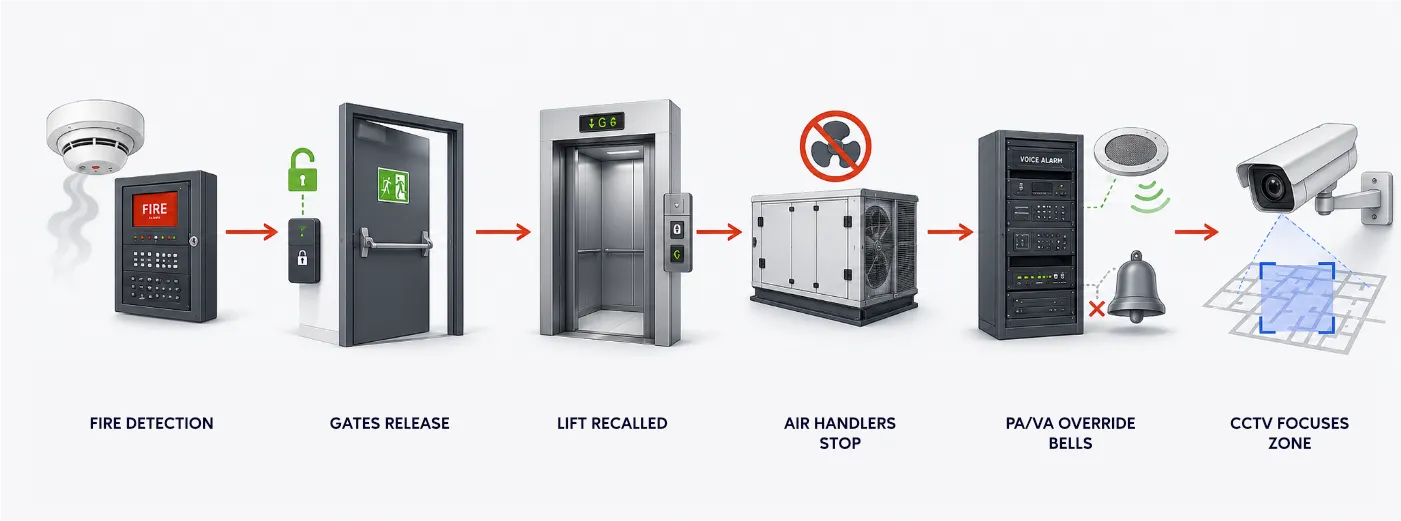
On a campus, the systems are only as good as the points where they meet. A safe evacuation depends on fire detection, doors, lifts, announcements and cameras acting as one. None of that happens by accident. It happens because the interfaces were drawn at design stage and tested before handover.
One integrated response to a single event
Fire event detected
Escape doors release
Lifts recalled
Air handlers stopped
PA/VA overrides bells
CCTV focuses the zone
When one team designs and commissions all of it under a single contract, those interfaces are one team's responsibility. When each system is a separate contract, the gaps between them belong to no one, until the day they fail.
On a campus
One integration partner
Single contract
Multiple specialist contractors
Separate contracts
Cross-system interfaces
fire→doors, network→exams, access→lockdown
Designed and tested by one team
Fall between contracts, surface at commissioning
Cause-and-effect evidence for the fire authority
One party presents it
Each contractor points to the next
Authority and handover documentation
Assembled as one package
Fragmented, gaps found late
Phasing around term and exams
One coordinated plan across systems
Each crew schedules around its own work
After handover
One support contract across systems
Separate contracts, disputed faults
Compliance and authority requirements
The compliance we own, by system
Compliance is easier to judge when you can see it by system. Here is what each system we deliver is designed, tested and approved against, for education projects in India, the UAE and Oman.
The network everything else runs on
Structured cabling and the data backbone that carries every digital service, designed for exam-day load, resilience and growth.
Authority approvalTest certification at handover
Designed, tested & certified to
TIA-568-D (2018)
Structured cabling design and performance
ISO/IEC 11801:2017
Generic cabling for customer premises
IEC 60364
Low-voltage electrical installations
Across all of them, you receive the evidence at handover: test certificates, the fire cause-and-effect matrix, network test results, and as-built drawings.
FAQs
Education building systems: questions buyers ask us
The questions school and university developers, estates teams and consultants ask before they specify.
A school needs the physical infrastructure its computers, projectors and software run on. That includes structured cabling and the network, access control, CCTV and visitor management, building management for heating and ventilation, public address and voice alarm, and addressable fire and life safety. Your learning platform, student records and devices sit on top of this layer. We deliver the layer, not the teaching software.
They act on shared logic designed and tested before handover. In a fire, the alarm releases the access-controlled doors on the escape route, recalls lifts, and triggers public address to override the class bells with a clear instruction by zone. In a lockdown, the same systems can secure a zone and direct people away from it instead. The interfaces are written into a cause-and-effect matrix and proven in an integrated test, not assumed.
Yes, with a phasing plan agreed with your estates and academic teams before any work starts. Cutovers are scheduled into holidays and low-activity windows, critical areas keep a tested fallback, and the method statement works around teaching and exams. The aim is that a building never loses a system it relies on at the moment it needs it.
Fire detection and alarm are designed to NFPA 72 (2022), BS 5839-1 and EN 54, with educational occupancy covered by NBC 2016 Part 4 in India. Approval comes from the state fire service and its no-objection certificate in India, UAE Civil Defence in the Emirates, and Royal Oman Police Civil Defence in Oman. We prepare the cause-and-effect matrix and commissioning evidence each authority asks for before it inspects, not after.
It will if it was designed for that peak rather than an average day. We size the wired network and WiFi for the number of students who log in at once, build in resilience so a single switch or link failure does not take a building down, and load-test against a real exam scenario before you depend on it. A network that only handles routine browsing is the most common reason online assessment fails.
As early as the design stage, while the consultant is still setting the systems scope. Early involvement lets the cross-system interfaces, cable routes and fire-rated cabling be designed in, rather than corrected on site later. If the project is already under construction, an integrator can still take it over, but the earlier the interfaces are agreed, the fewer surprises at commissioning.
Book a campus systems assessment
A clearer scope for your campus, whether or not you work with us
Tell us about your education project and a senior engineer reviews it with you, then sets out what your systems need and where the risks are.
An engineer who has delivered education systems contacts you, not a salesperson
You get a response within one business day
No cost and no obligation for the assessment
If a single specialist contractor is the better fit, we will say so
Tell us about your education project
Response within one business day. No cost, no obligation.