
Energy management · Building management systems

Energy management system integration that shows where your energy goes and proves what you save

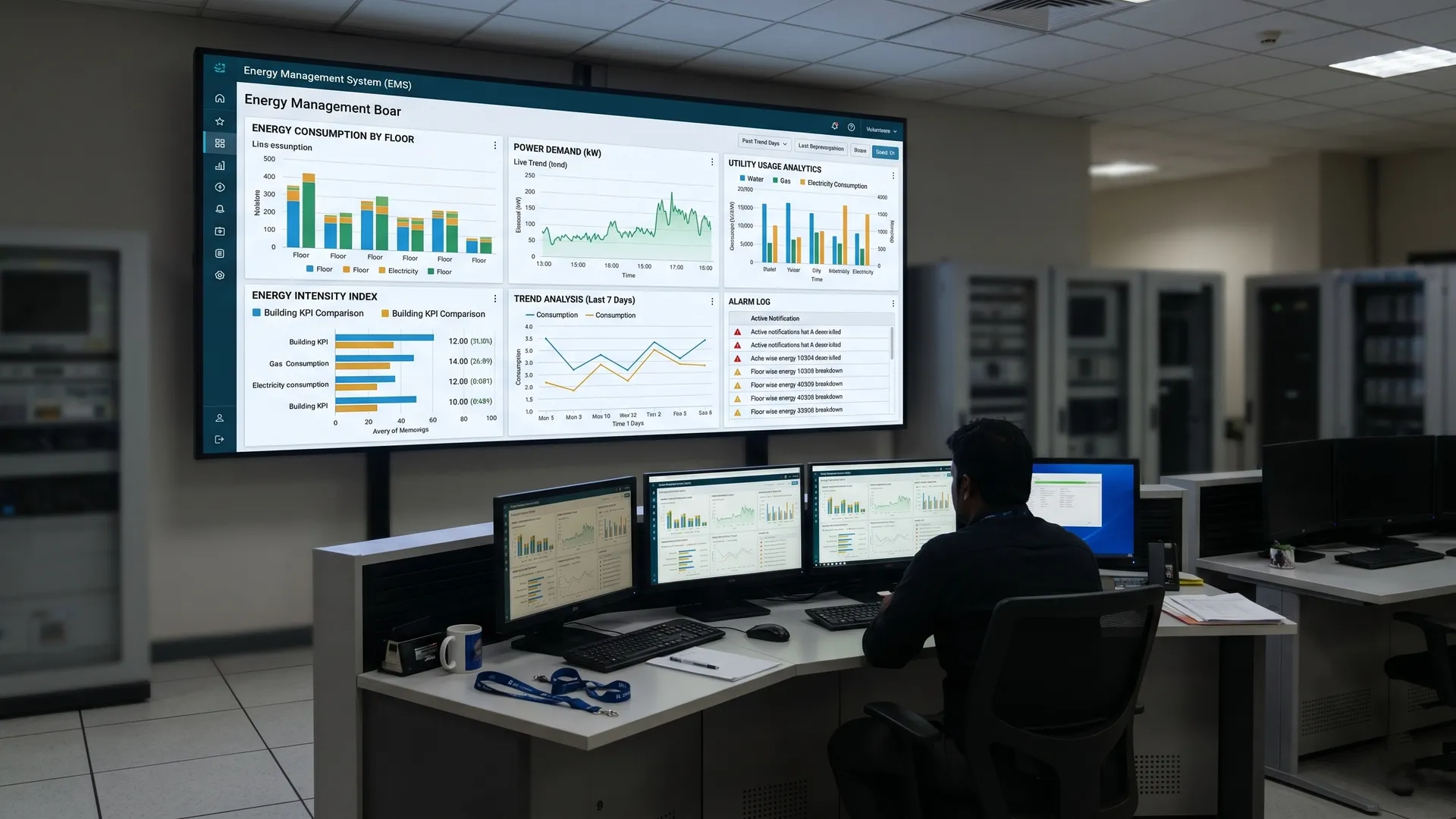
Energy management system dashboard in a commercial building control room
100%
meters verified end to end before you sign the handover

One metering, monitoring and analytics layer that finds, targets and verifies energy savings across your building.

You already pay the energy bill every month. What you often cannot see is which floor, tenant, or system is driving it. An energy management system fixes that gap. It meters consumption across your building, puts the data on one dashboard, and measures any saving against a verified baseline, so you can prove a reduction actually happened rather than hope for one. We design and integrate these systems to ISO 50001:2018 and the IPMVP measurement and verification protocol, using open BACnet and Modbus metering so your data is never locked to a single vendor.

ISO 50001:2018IPMVP measurement & verificationMeters verified before handover
Building management systems overview
A certified energy engineer replies within one business day, not a sales rep.
What it is

What an energy management system includes

An energy management system is the metering and analytics layer that measures, attributes and reduces what your building consumes. It connects electricity, thermal, water and gas meters to a network of loggers and a central dashboard, then uses that data to find waste, bill tenants and prove savings. People also call it an energy monitoring system or a building energy management system (BEMS). A complete scope is more than software. It covers the energy audit, the metering plan, the meters and current transformers, the data collection, the dashboards and analytics, and the measurement and verification, from the first survey through to a documented handover your facilities team can run on its own.
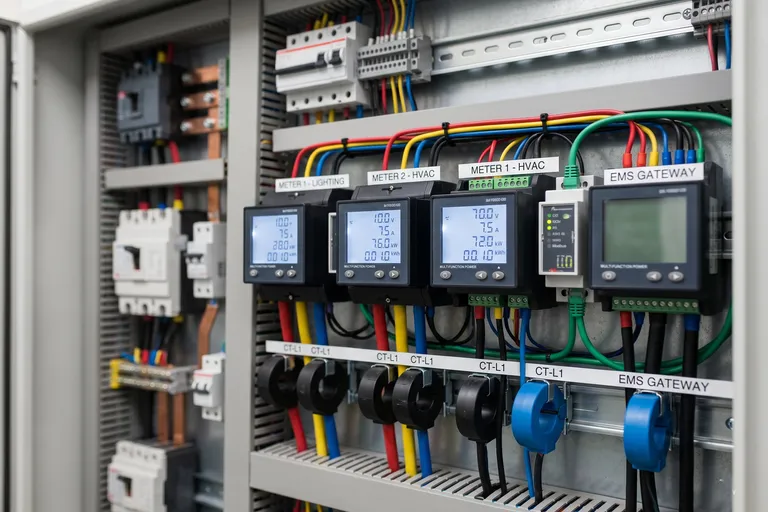
Sub-metering panel with power meters and current transformers

Metering and sub-metering

Revenue-grade electricity, thermal (BTU), water and gas meters, placed where you need to attribute cost.

Data collection and gateways

Loggers and gateways that pull every meter onto one network over BACnet or Modbus, with no manual readings.

Energy dashboards and analytics

Dashboards that show consumption by floor, tenant and system, with fault and anomaly alerts.

Measurement and verification

A baseline set to the IPMVP method, so any saving is measured against a real before figure, not estimated.

Tenant and landlord billing

Automated tenant billing from sub-meter data, with an audit trail you can stand behind.

BMS and system integration

Meter data tied back to the building automation system, so control decisions use real consumption.

The metering plan and the baseline method are agreed and approved before any meter is ordered. Nothing is procured until you confirm what each meter is there to answer.

Risks

What goes wrong with energy management systems

Four failures that show up after the meters are live. Each one is a design or commissioning decision, not bad luck, and each is preventable before a single meter is installed.

Risk 01

Meters installed, data never acted on

The meters go in, the dashboard goes live, and then nothing changes because no one set a baseline or owns the follow-through. Without a before figure, a saving is impossible to prove, so the screen becomes something nobody opens. We have walked into buildings with full metering where not one setpoint or schedule had moved since handover.

No baseline
with no before figure, a saving can never be proven on your utility bill.
Prevention

Set an energy baseline to the IPMVP method before any optimization, and agree who owns acting on the data after handover.

Specification

Technical specification

Your energy management system is designed to open standards, not to one manufacturer's ecosystem. Meters and gateways communicate over BACnet (ANSI/ASHRAE Standard 135) and Modbus, so devices from different makers report to one platform. Energy performance follows ISO 50001:2018, and savings are measured to the IPMVP measurement and verification protocol with ASHRAE Guideline 14 where deeper analysis is needed. Meters are selected by duty: revenue-grade where you bill from them, monitoring-grade where you only watch a trend. Before handover, every meter is verified end to end and the energy baseline is recorded, so later savings can be measured against a real number.
Standards
ISO 50001:2018 (energy management systems) · IPMVP and ASHRAE Guideline 14 (measurement & verification) · ASHRAE 90.1 (energy efficiency)
Protocols
BACnet/IP and BACnet MS/TP · Modbus RTU/TCP · M-Bus for utility meters · OPC UA where integrating to analytics or IT systems
Meters & field devices
Electricity meters to IEC 62053-22 Class 0.5S · power-monitoring devices to IEC 61557-12 · thermal (BTU) meters to EN 1434 · current transformers · water and gas meters
Systems metered
Incoming supply · chiller plant and HVAC · pumps and motors · lighting and small power · tenant areas · renewables where present
System integration
Metering reports to the building automation system on its own network segment · links to tenant billing and analytics platforms
Measurement & verification
Baseline recorded before optimization · energy performance indicators (EnPIs) tracked · actual reported against baseline to the IPMVP method
Handover documentation
As-built meter schedule · points list · baseline and M&V method · exported dashboards · operator guide
Warranty
Manufacturer warranty on meters and gateways; extended cover activated at certified, commissioned handover
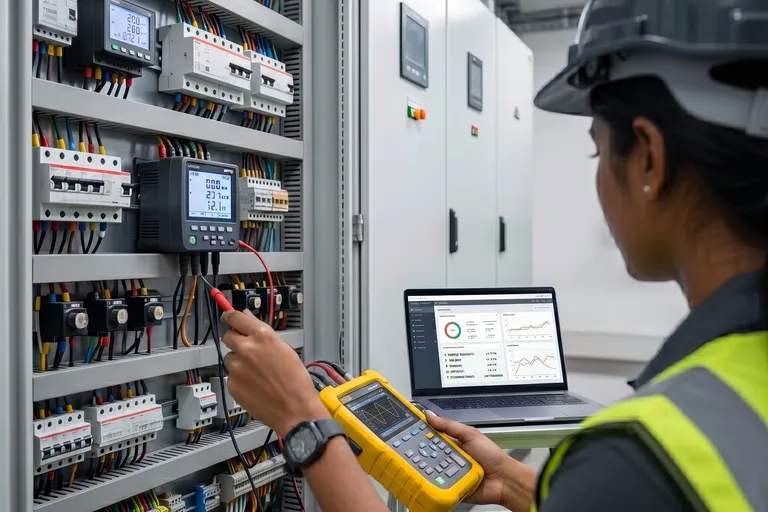
Engineer verifying meter accuracy during energy management commissioning
The as-built meter schedule, the baseline and the exported dashboards are included as standard, in formats your team owns.
Cost factors

What affects the cost of an energy management system

The cost of an energy management system moves with the number of metering points, how deep the sub-metering goes, the accuracy class of the meters, how much it integrates with other systems, the depth of analytics and billing, and whether it is retrofitted into a live building or designed in from the start. We publish the drivers, not a price, because a real figure comes from your metering plan and your building, not a rate card.

Bank of energy sub-meters and current transformers in a distribution board
Metering point count

Every meter and monitored circuit adds hardware, wiring and configuration. The number of points is the single biggest driver of cost.

Sub-metering depth

Metering by tenant and by system costs more than a few main feeders, and tells you far more about where the cost sits.

Meter accuracy and type

Revenue-grade and thermal (BTU) meters cost more than basic monitoring meters; the right class depends on whether you bill from them.

Integration and protocol

Tying meters into an existing BMS, analytics platform or billing system adds interfacing and testing time.

Analytics and software depth

Custom dashboards, tenant billing and fault-detection analytics add value and add engineering hours.

Retrofit or new build

Fitting current transformers and cabling into a live, occupied building costs more than metering designed in from the start.

Standard exclusions(not included in an energy management quote)
Modifications to live LV switchgear, busbars and distribution boards by the electrical contractor
Power supply, containment and builder's work for meters and gateways
ICT network and internet links beyond the metering segment
Software, cloud or analytics licences beyond the initial term
Utility bill validation and tariff negotiation with the supplier
Operational and behavioural energy-saving measures by the facilities team
Annual maintenance contract (AMC)
Process

How an energy management project is delivered

Every project runs in five phases. No phase starts until the previous one is complete and documented.

01

Energy audit and metering plan

Your project starts with an energy audit and a metering plan: what to meter, at what level, and which question each meter must answer. From that comes a points list, a baseline method and a meter schedule you review before anything is bought.

No meter is ordered until the metering plan and the baseline method are approved.
02

Procurement and configuration

Meters, current transformers, loggers and gateways are procured to the schedule and prepared off site where possible, with the analytics platform and dashboards configured to your metering plan ahead of site work.

Meter schedule and dashboard structure reviewed before any site work begins.
03

Installation and integration

Meters and current transformers are installed at the agreed points, wired to loggers and gateways on their own network segment, and integrated with your building automation and billing systems. Each meter is labelled and recorded.

No meter left uninstalled, unlabelled or off its segment at the end of any day.
04

Commissioning, baseline and verification

Every meter is verified end to end from current transformer to dashboard, readings are checked for accuracy and polarity, and the energy baseline is recorded before any optimization so later savings can be measured against it.

Every meter proven accurate and the baseline recorded before handover is offered.
05

Handover and documentation

Handover is not signed until the as-built meter schedule, the points list, the baseline and M&V method, the exported dashboards, and operator training are produced and accepted by your team.

Not signed off until every document is accepted and your team can read the data.
Key comparison

Integrated, standalone or cloud: how should your energy management system be built?

How your energy management system is built decides how deep your analysis can go, where your data lives, and what it costs to run for the next 10 to 15 years.

Compare options
Select a category
Depth of analytics
Solid; uses the BMS head-end and graphics
Deepest; purpose-built energy analytics
Strong, delivered from the vendor cloud
Sub-metering granularity
By system and tenant on the BMS network
By system, tenant and circuit, very fine
Depends on the meters feeding the cloud
Where your data lives
On your own network
On your own network or server
On the vendor's cloud
Measurement & verification
Baseline and reporting in the BMS
Full IPMVP tooling and EnPIs
Automated reports on vendor templates
Ongoing cost
No separate platform fee
Software licence or maintenance
Subscription per meter or per site
Best for
A single building already getting a BMS
ISO 50001 programmes and deep analysis
Estates of many sites compared centrally

For a single building that is already getting a building automation system, integrating metering into the BMS gives you one dashboard, one network and no extra licence to run. A standalone energy platform earns its place where you need deep analysis or a formal ISO 50001:2018 programme. Cloud or portfolio analytics suits estates of many sites compared from one place. We design open either way, so your meters are never stranded on one vendor.

Cross-service

What your energy management system connects to

Your energy management system rarely runs alone. It measures the loads other systems control, and it reports over the same network. These are the connections that belong in the design from the start, not bolted on after handover.

Building automation and HVAC

Most of your energy is moved by HVAC and chiller plant. Metering means little unless it ties back to the controls that run them, so the two are designed together.

View building automation

ICT network backbone

Your meters and gateways report over the building network. The metering segment is designed alongside the cabling, on its own segment, off the corporate traffic.

View structured cabling

Lighting control

Lighting is a major, controllable load. Metering it and linking to lighting control turns visibility into an actual saving instead of a chart.

View building management systems

Tenant fit-out and billing

Where you bill tenants for energy, the sub-meter boundaries and billing rules belong in the design, not in a dispute after occupancy.

View building management systems
Relevant industriesHospitalityData centresHealthcareManufacturing
FAQs

Frequently asked questions

The questions buyers ask about energy management systems before they specify a project.

It can, but the savings come from acting on the data, not from the meters themselves. An energy management system shows you where energy goes, sets a baseline, and measures what changes after you adjust schedules, setpoints or plant. We meter the systems that drive your consumption and report actual savings against the baseline using the IPMVP method. Without that baseline and metering, any saving figure is a claim, so we put the measurement in writing.

A building management system controls your plant; an energy management system measures and improves what that plant consumes. The BMS runs HVAC, chillers and lighting in real time. The energy management system meters consumption, attributes it by floor, tenant or system, and verifies savings over time. The two are designed to work together: the BMS acts, the energy management system proves the result.

Often you can add metering to an existing system, depending on what you already have. We survey your current meters, protocols and network first. Where the building management system runs on an open protocol like BACnet or Modbus, we add meters and an analytics layer rather than replace anything. Where the existing system is closed or undocumented, we show you the honest comparison between extending it and starting clean before you spend.

Meter to the level at which you can act on the result, not deeper for its own sake. Utility-level metering tells you the building total but not the cause. Metering by floor, tenant and major system, such as chillers, pumps, lighting and small power, lets you find and fix the cost. We set the metering boundary with you during the audit, so every meter answers a question you will actually use.

No, certification is optional, but designing to ISO 50001:2018 is worth it either way. The standard gives you a structured way to set a baseline, track energy performance indicators and show continual improvement. You can run that discipline without seeking formal certification. If you do want to certify later, the metering and measurement-and-verification we put in place give you the evidence an auditor asks for.

The cost depends on how many metering points you need, how deep the sub-metering goes, the meter accuracy class, and the analytics and verification scope. A building that meters every tenant and major system at revenue-grade accuracy costs more than one tracking a few main feeders. We do not publish a rate card because a real figure comes from your metering plan, not an average. Book an energy assessment and you get an indicative budget range for your building in writing.

Honest fit

When we are not the right choice

We will tell you directly when your project is not the right fit.

You expect lower bills without changing how the building runs

An energy management system measures and reveals waste; it does not operate the plant for you. The savings appear when someone acts on what the data shows, by retuning schedules, setpoints or plant. If no one will own that follow-through, the dashboard becomes a screen nobody opens, and you will not see the return. We will say so before you invest.

Your tender is scored on lowest price alone

We will not strip out sub-metering depth, meter accuracy or measurement and verification to match a cheaper number. A proposal that leaves those out cannot attribute or prove savings, which is the entire point of the system. That is a different scope, not a better deal.

You run a single small space on one meter

For a small office on a single utility meter, your bill and a low-cost plug meter will tell you most of what you need. A full energy management system is more than that space requires. We focus on buildings with multiple tenants, systems or sites where energy has to be attributed and verified.

You're a good fit if…

Your building has real energy cost to manage, with multiple tenants, floors or major plant, where you need to attribute consumption, bill tenants accurately, prove savings against a baseline, or report under ISO 50001:2018, and where the metering has to stay reliable and auditable for years.

Book an energy assessment

A metering plan to test energy proposals against before you tender

An energy assessment gives you a draft metering-plan outline, a baseline approach for your building, and an indicative budget range, so procurement compares proposals that cover the same work.

A certified energy engineer contacts you, not a sales representative
Response within one business day
An indicative metering-plan outline and budget range in writing within five business days of the site visit
No obligation. If we are not the right fit, we will tell you directly

Tell us about your project

Response within one business day. No obligation.