
Environmental Monitoring · ELV Systems

Environmental monitoring systems that catch heat, humidity and leaks before they cause downtime

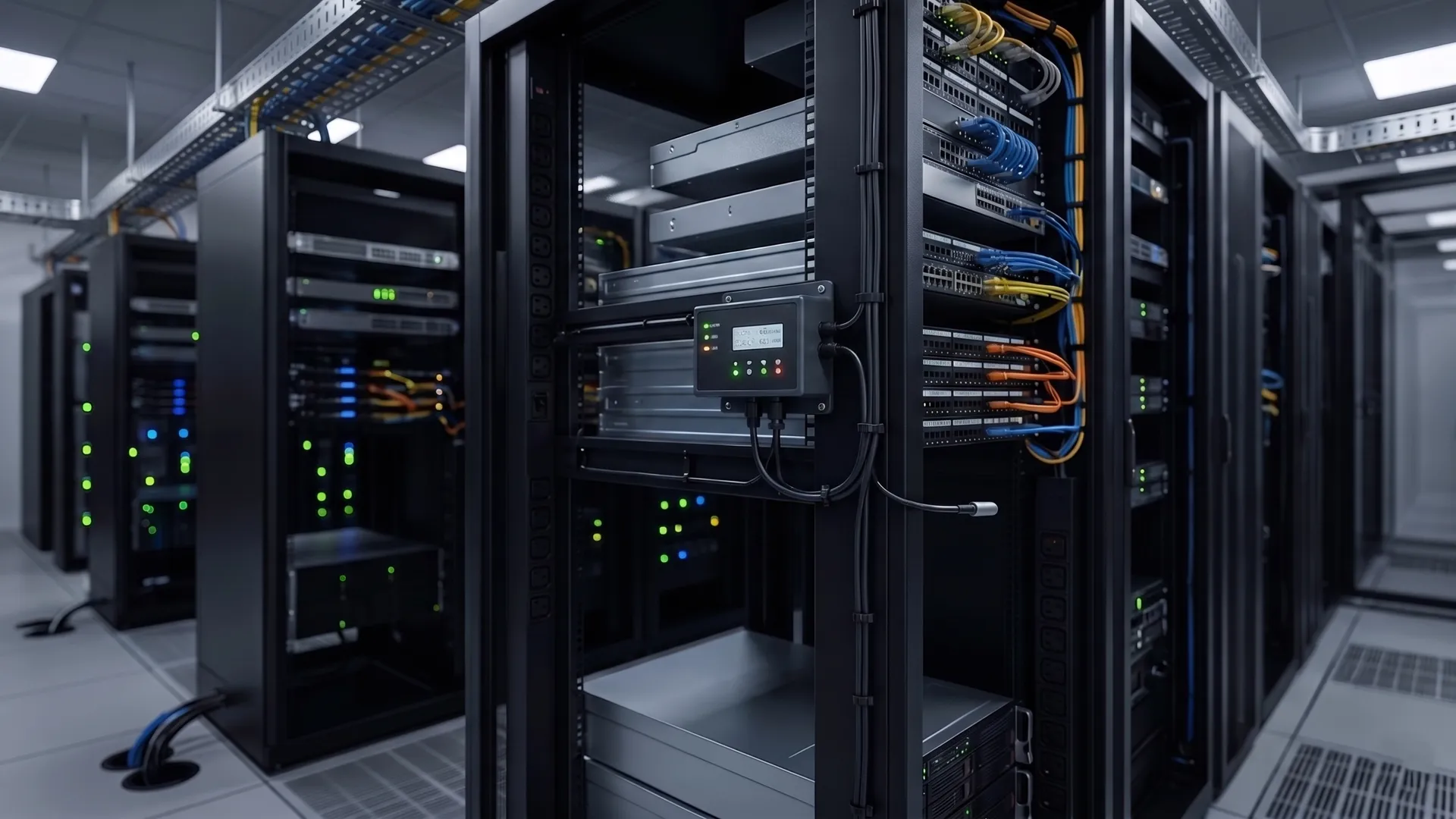
Environmental monitoring sensors mounted on a server rack in a data centre
100%
of alarm paths tested before handover

Early warning on temperature, humidity and leaks, before a drift becomes downtime.

If you run a data centre, server room or any space where equipment fails when conditions drift, an environmental monitoring system gives you early warning before heat, humidity, water or smoke reach your critical assets. The scope covers the full process: a risk survey of every rack and room, temperature, humidity, leak and airflow sensors placed where problems start, integration with your building management system, and alerts that reach the right person by a route they will actually see. Sensor placement follows the ASHRAE TC 9.9 thermal guidelines, and every alarm path is tested before handover.

Calibrated sensorsASHRAE-alignedAlarm-tested
ELV systems overview
A monitoring systems engineer replies within one business day, not a sales rep.
What it is

What an environmental monitoring system includes

An environmental monitoring system is the network of sensors, controllers and alerting software that watches the physical conditions around critical equipment, such as temperature, humidity, water, airflow, power and smoke, and warns you the moment a reading drifts outside a safe band. A complete scope covers the risk survey, the sensors and where they sit, the network and power each one needs, integration with your BMS and command centre, and the calibration and testing that make the alerts trustworthy.
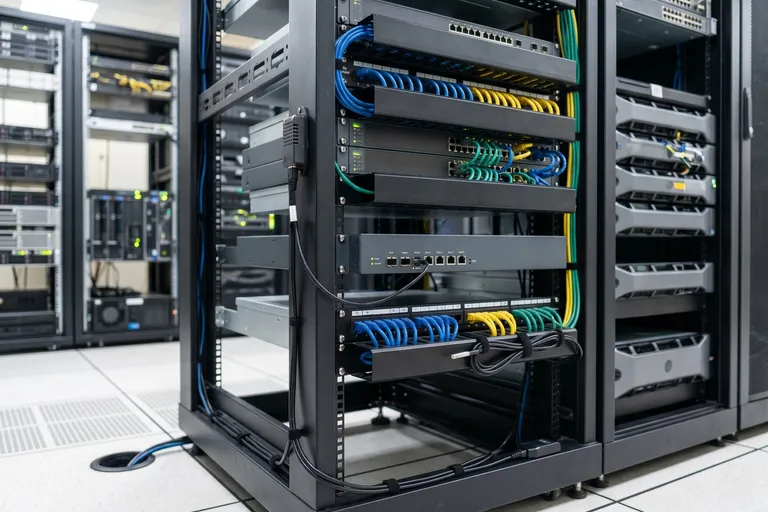
Environmental monitoring gateway and rack sensors in a server room

Risk survey & sensor design

Room and rack survey, risk points, safe-band thresholds, and a sensor placement plan.

Sensors & detection

Temperature, humidity, water leak, airflow, smoke, power and door sensors matched to each space.

Power & network provision

Dedicated power, network drops, and containment for every sensor and gateway.

System integration

BMS, command centre, and alerting by SMS, email, voice call and dashboard.

Calibration & alarm testing

Sensor calibration, threshold setting, and every alarm path tested end to end.

Handover & operator training

As-built records, calibration certificates, and operator and escalation training.

Sensor placement and alarm thresholds are agreed before any equipment is ordered. Nothing is procured until the monitoring design and the escalation plan are confirmed.

Risks

What goes wrong with environmental monitoring systems

Four failures that show up after the sensors are installed. Each one is preventable at design stage.

Risk 01

Sensors placed where it is convenient, not where heat builds

A single sensor on a wall reports a room average and misses the hot spot forming between two high-density racks. By the time the average rises, the equipment in the hot aisle has already been cooking. Placement is a design decision, not an afterthought.

3
sensor heights per rack catch what one misses (top, middle, bottom).
Prevention

Place sensors at rack intake and exhaust and at known hot spots, per ASHRAE thermal guidance.

Specification

Technical specification

Environmental monitoring at Yakkaservices is designed around your rooms and the equipment in them, not a single product line. Sensors are selected by what each space must detect, how fast a problem develops there, and how it must be reported. Temperature and humidity sensors sit at rack intake and exhaust to the ASHRAE thermal envelope, water-leak detection runs as spot probes or sensing rope under floors and near cooling units, and every sensor is calibrated and every alarm path tested before the system goes live.
Standards & guidelines
ASHRAE TC 9.9 thermal guidelines (data-centre temperature and humidity envelope) · EN 50600 data-centre facilities · ISO/IEC 11801:2017 for sensor cabling · NFPA 75/76 where monitoring ties into IT-room fire protection, confirmed per site
Sensor categories
Temperature & humidity · spot and rope water-leak detection · airflow and differential pressure · smoke and very-early smoke detection · power and UPS status · door/contact and particulate (cleanroom)
Protocols & technology
BACnet/IP · Modbus TCP · SNMP · dry-contact and analogue inputs · IP and wireless sensor gateways
System integration
Building management system (BMS) · command centre · CCTV · fire alarm and suppression interface · SMS, email, voice-call and dashboard alerting
Testing method
Sensor calibration against reference · threshold verification · end-to-end alarm-path testing to every escalation channel
Handover documentation
As-built sensor drawings · calibration certificates · alarm and escalation matrix · operator training records · warranty registration
Warranty
Manufacturer warranty activated at certified handover; AMC available for calibration and sensor checks
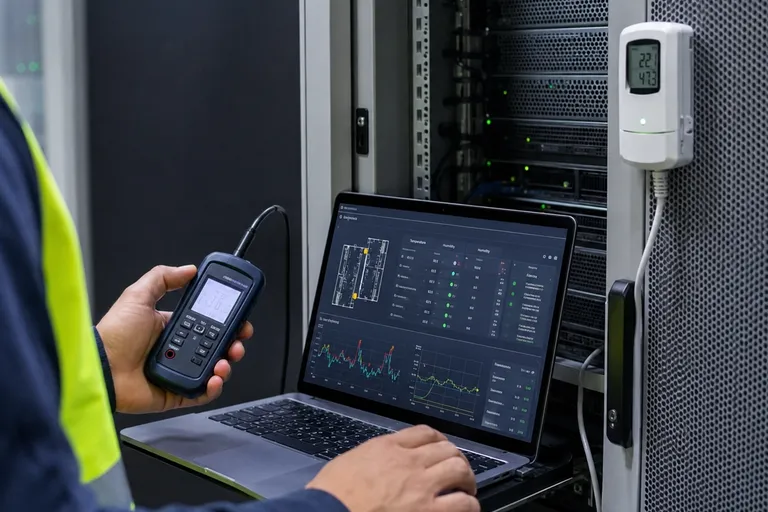
Engineer calibrating an environmental monitoring sensor before handover
Calibration certificates and alarm-path test records included as standard.
Cost factors

What affects the cost of an environmental monitoring system

The cost of a monitoring project varies with the number of points you watch, the sensor types in each space, the alerting and software, power and network readiness, integration depth, and how much resilience you build in. A single server room and a multi-hall data centre sit at very different points, so a per-sensor figure means little without a site survey.
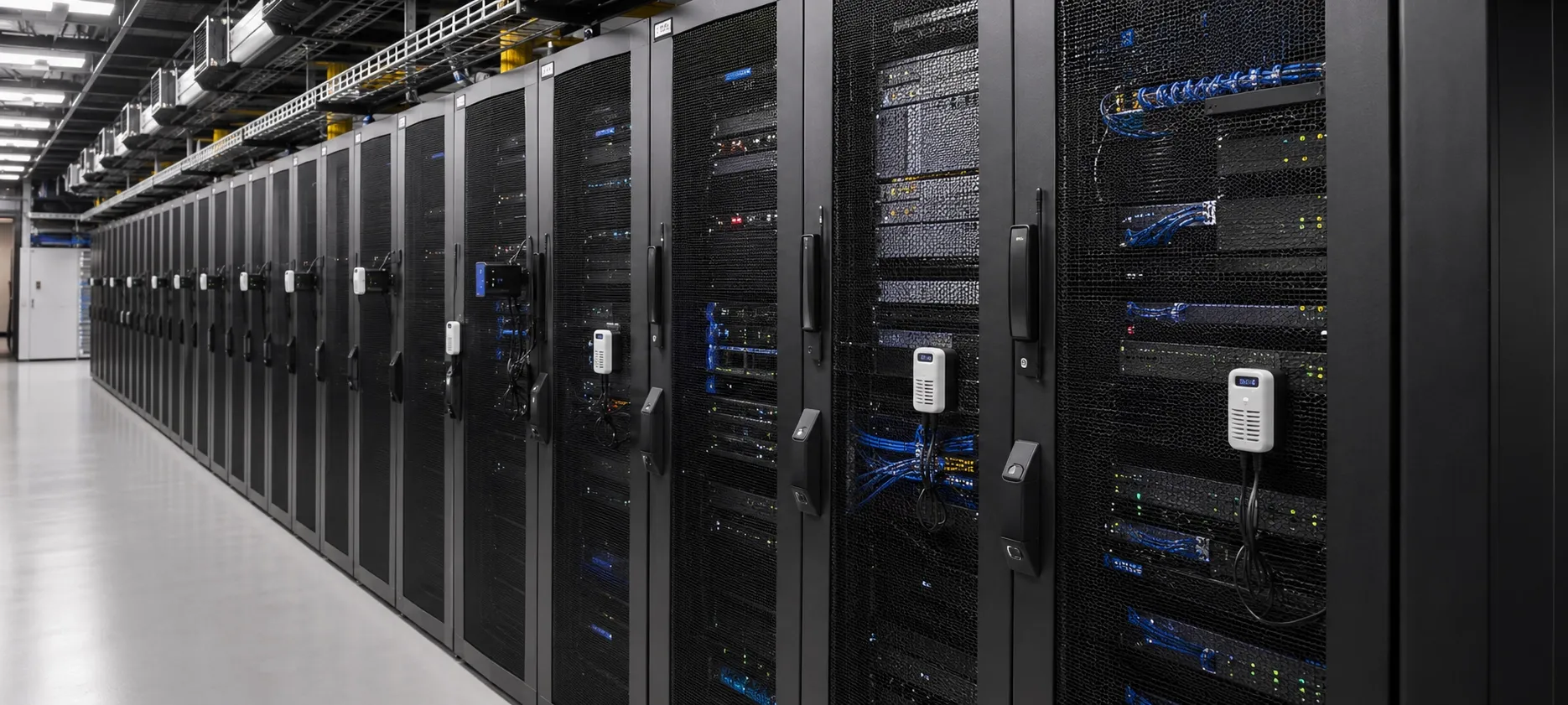
Environmental sensors monitoring multiple server racks across a data-centre hall
Number of monitored points

Set by how many racks, rooms and risk points you cover; each sensor adds hardware and configuration.

Sensor types

Temperature and humidity are inexpensive; leak rope, very-early smoke and particulate sensors cost more.

Alerting and software

A hosted dashboard with SMS and voice escalation costs more than basic local alarms, and pays back in response time.

Power and network readiness

New cabling, gateways and battery backup add cost; existing containment and drops reduce it.

Integration depth

Linking to your BMS, fire system and command centre adds engineering over standalone sensors.

Redundancy and resilience

Independent power and a separate alerting path raise cost but keep monitoring alive during an incident.

Standard exclusions(not included in a monitoring quote)
Civil and builder's work (containment, power feeds)
Active IT and cooling equipment being monitored
BMS or third-party platform licences
Replacement of faulty equipment found during the survey
Network hardware beyond the sensor gateways
Annual maintenance contract (AMC)
Process

How an environmental monitoring project is delivered

Every project follows five phases in sequence. No phase begins until the previous one is complete and documented. Nothing is ordered until the design and the escalation plan are agreed, and no system goes live until every alarm path passes testing.

01

Risk survey & sensor design

Your project starts with a survey of every room and rack. We identify hot spots and leak risks, set safe-band thresholds, and produce a sensor layout with the type selected for each point.

No equipment ordered until the sensor design is approved.
02

Threshold & procurement gate

The alarm thresholds and the escalation matrix are agreed here, so the system knows what to report and who to tell. Equipment is ordered once the design and the escalation plan are both confirmed.

Escalation plan agreed before procurement.
03

Power, network & installation

Containment, power feeds and gateways are made ready before the sensors arrive. Sensors are then installed and mounted to the approved layout.

Power and network readiness confirmed before sensors are mounted.
04

Integration & alarm testing

Each sensor is connected to your BMS and command centre, then calibrated against a reference. Every alarm path is tested end to end, to every escalation channel.

Every alarm path tested before go-live.
05

Operator training & handover

Operators are trained on the dashboard and the escalation process. Handover is not signed until as-built drawings, calibration certificates, the alarm matrix and warranty registration are produced and accepted.

Not signed off until operators are trained and documents accepted.
Key comparison

Built-in BMS sensors, dedicated monitoring or none: what a critical space needs

The right approach depends on what is in the room and what it costs you when conditions drift. Plant-level cooling sensors tell you the room is warm; they rarely tell you which rack, or that water is pooling under the floor. The wrong choice leaves a blind spot exactly where your most valuable equipment sits.

Compare options
Select a category
What it covers
Plant-level temperature and a few cooling points
Per-rack temperature, humidity, leak, airflow, smoke and power
Whatever a walk-round happens to notice
Where it is blind
Hot spots between racks; leaks under the floor
Designed to remove blind spots at rack and room level
Everything between manual checks
Alerting
Often dashboard-only, no out-of-hours escalation
SMS, voice call, email and dashboard with escalation
None until someone walks in
Resilience
Fails with the system it lives in
Battery-backed sensors, independent alerting path
No detection during an incident
Best for
Comfort cooling and plant rooms
Data centres, server and UPS rooms, cleanrooms, archives
Low-value spaces with no critical equipment

For any space holding critical equipment, a dedicated environmental monitoring system removes the blind spots that plant-level BMS sensors leave and gives you an alert path that survives the incident. Built-in cooling sensors complement it; they do not replace it.

Cross-service

What other systems your monitoring connects to

Monitoring is rarely a standalone purchase. The sensors share power, network and a command centre with the rest of your estate, and the value comes from how they connect. A monitoring scope that ignores those links creates coordination gaps during installation and blind spots after handover.

Building management system

Environmental alarms belong on the same dashboard your facilities team already watches, with monitoring adding the rack-level detail a plant BMS does not see.

View BMS integration

Structured cabling & power

Every sensor and gateway needs a network drop and a power feed back to your core. Leave them out of the cabling scope and they return later as a variation order.

View structured cabling

Fire detection & suppression

Water-leak and very-early smoke sensors give warning minutes before a fire system acts, and should hand off cleanly to suppression rather than duplicate it.

View ELV systems

ELV systems integration

Monitoring sits inside your wider extra-low-voltage estate alongside CCTV, access control and intercom. One integration scope removes the gaps between separate contractors.

View ELV systems
Relevant industriesData centresHealthcare & hospitalsBanking & finance
FAQs

Frequently asked questions

The questions buyers ask about environmental monitoring systems before they specify a critical space.

A building management system watches plant-level conditions; a dedicated environmental monitoring system watches the conditions at each rack and room where equipment actually fails. Built-in cooling sensors tell you the room average, not the hot spot between two high-density racks or the leak forming under the floor. The two work together: monitoring adds the granular detection and the out-of-hours alerting a plant BMS was never designed to provide.

Temperature and humidity at rack level are the baseline, placed at intake and exhaust per ASHRAE thermal guidance. Beyond that, water-leak detection under raised floors and near cooling units, airflow or differential pressure, very-early smoke, and power or UPS status all matter for a critical space. The survey sets which of these your rooms need rather than fitting every sensor everywhere.

Alerts are raised the moment a reading crosses its threshold and follow an escalation chain you define. That usually means a dashboard alarm first, then SMS, email and a voice call to the on-call person if it is not acknowledged. The point of the escalation matrix is that a 2am alert reaches someone who can act, not an inbox read the next morning.

It should, and that is a design decision. We specify battery-backed sensors and gateways and an alerting path that does not depend on the same network or power the system is monitoring. Without that, the monitoring goes silent during the exact incident it exists to catch.

It depends on how many points you monitor, the sensor types, the alerting and software, and how deeply it integrates with your BMS and fire systems. A single server room and a multi-hall data centre sit far apart, so a per-point figure means little before a survey. We give you a budgetary estimate built around your actual rooms and racks after the assessment.

Yes. Sensors report over BACnet, Modbus or SNMP, so environmental alarms can appear on the BMS dashboard your team already uses. Leak and very-early smoke detection can also hand off to your fire and suppression systems so warning and response are coordinated rather than duplicated. We confirm the protocols your existing systems support during the survey.

Honest fit

When we are not the right choice

We will tell you directly when your project is not the right fit for us.

You need a single plug-in sensor for one cupboard

If you want one temperature sensor with an app for a small comms cabinet, an off-the-shelf product will cost less and ship faster. We design integrated, calibrated and alarm-tested monitoring for critical spaces, not single-sensor sales.

Your tender is judged on lowest price only

We do not strip out calibration, integration or alarm-path testing to match a lower number. A quote that leaves those out is a different scope, not a cheaper version of ours.

You only want a dashboard, not a designed system

If you already have sensors and only need a screen to show them, a software-only vendor fits better. Our value is in placing the right sensors and proving every alarm reaches someone who can act.

You're a good fit if…

Your project is a data centre, server or UPS room, cleanroom, hospital or archive where equipment fails when conditions drift, you need monitoring integrated with your BMS and command centre, and you need every sensor calibrated and every alarm path tested before it goes live.

Book an environmental monitoring assessment

A monitoring design to test proposals against before you go to tender

An environmental monitoring assessment gives you a sensor layout, an alarm and escalation plan, the integration path to your BMS, and a budgetary estimate built around your rooms and racks, so procurement compares proposals that cover the same work.

A monitoring systems engineer contacts you, not a sales representative
Response within one business day
Sensor layout, alarm matrix and budgetary estimate in writing within five business days of the site visit
No obligation. If we are not the right fit, we will tell you directly

Tell us about your project

Response within one business day. No obligation.