

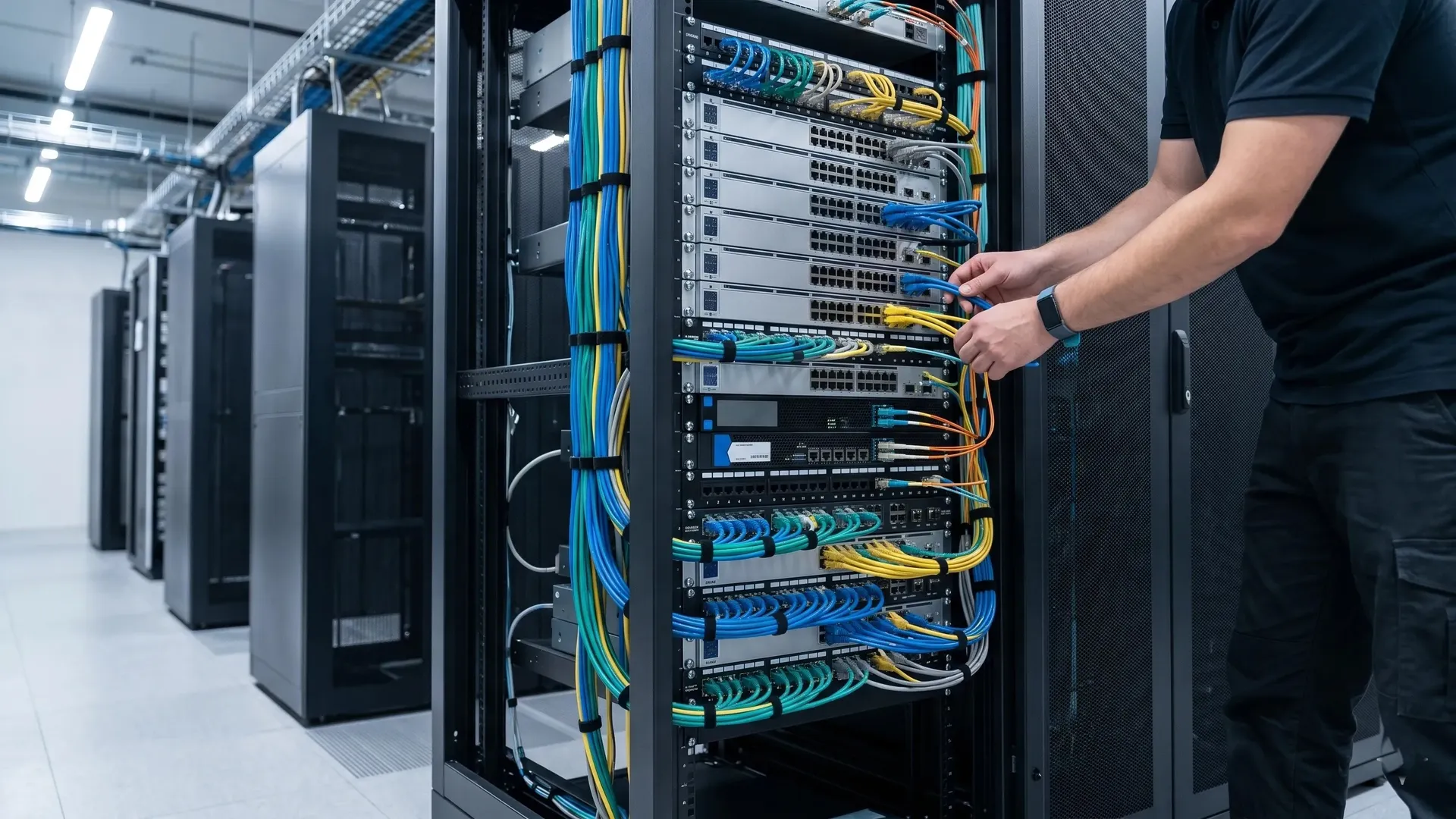
What network infrastructure services include
Your network infrastructure is the active layer that sits on top of your structured cabling: the switches, routers, wireless access points, firewalls, and SD-WAN that move traffic between your people, your servers, your building systems, and the internet. A complete scope covers the design, the equipment selection, the configuration, the segmentation, and the testing, from the first site survey through to a documented handover your IT team can run on its own.

Campus and LAN switching
Core, distribution, and access switches sized for your user count and PoE load.
Data-centre networking
Top-of-rack and spine switching for your server rooms and data halls.
WiFi (Wi-Fi 6 / 6E)
Access points placed from a wireless survey, not guesswork, to IEEE 802.11ax.
Firewalls and perimeter
Next-generation firewalls configured for your traffic, not left on defaults.
Secure SD-WAN
Resilient links between your sites with encrypted, policy-based routing.
Segmentation and OT/IT separation
Building systems kept on their own segments, off your corporate network.
The network design, IP addressing plan, and segmentation map are agreed and approved before any equipment is ordered. Nothing is procured until the design is confirmed.
What goes wrong with enterprise networks
Four failures that show up after the network is live. Each one is a design decision, not bad luck, and each is preventable before a single switch is configured.
Technical specification
Your network is designed to recognised standards, not to one vendor’s playbook. Switching follows IEEE 802.3, wireless follows IEEE 802.11ax, and the cabling backbone underneath is built to TIA-568-D (2018) and ISO/IEC 11801:2017. Equipment is selected for your traffic and your uptime target, segmentation follows IEC 62443 wherever operational technology is involved, and every link is channel-tested while segmentation and failover are validated before handover.

What affects the cost of a network infrastructure project
The cost of a network project moves with the number of switches and ports, your uptime and redundancy target, wireless density, how deep your segmentation goes, the number of sites on SD-WAN, and how much existing equipment can be reused. We publish the drivers, not a price, because a real figure comes from your design.


Cloud-managed, on-premise controller, or standalone: how should your network be run?
How your network is managed decides how fast you see problems and how much it costs to run.
For most multi-site organisations with a lean IT team, cloud-managed networking gives you the fastest visibility and the simplest changes, at the cost of an ongoing subscription. If you run one large campus and want policy kept entirely on your own network, an on-premise controller fits better. For a single small site that rarely changes, standalone hardware avoids a recurring fee you do not need.
What else runs on the network you build
Your network is the layer most other building systems travel on. These are the connections that belong in the network design from the start.
Structured cabling
Your network is only as fast as the cabling beneath it. The two are designed together, so the physical layer carries the speeds and PoE your switches and access points need.
View structured cablingIP CCTV and access control
Cameras, access readers, and intercoms run on this network. They sit on their own segments, isolated from your corporate traffic.
View ELV systemsEnterprise wireless and data centre
WiFi access points and data-centre switching are part of the same network design. See how they fit the full ICT scope.
View ICT servicesBuilding management systems
HVAC, metering, and lighting controllers connect over the network using BACnet/IP. They belong on their own segment, planned into the network design.
View BMS servicesFrequently asked questions
The questions IT teams ask about network infrastructure before going to tender.
When we are not the right choice
We will tell you directly when your project is not the right fit.
Your tender is scored on lowest price alone
We will not remove segmentation, testing, or documentation to match a cheaper number. A proposal that leaves those out is a different scope, not a better deal.
You run one small site with a capable in-house IT team
For a handful of switches and a single access point, your own team or a local IT provider will deliver it faster and for less than we will.
You want a single-vendor, locked-down stack
We design to open standards and hand over editable configurations. If a closed, proprietary system you cannot change later is the goal, we are not the right fit.
You're a good fit if…
You are a good fit if your network carries more than office traffic, with CCTV, access control, building systems, and WiFi on one infrastructure, where segmentation and security matter, where you need a documented handover your team can run, and where the network has to perform reliably for the next ten years or more.
A scope to test network proposals against before you tender
A network assessment gives you a segmentation outline, a review of your current switches and cabling, and an indicative budget range for your building, so procurement compares proposals that cover the same work.
Tell us about your project
Response within one business day. No obligation.
Related resources
ICT infrastructure services overview
How network infrastructure fits the full ICT scope: structured cabling, enterprise wireless, and data-centre systems.
View ICT servicesStructured cabling
The physical layer your network rides on, channel-certified at every outlet.
View structured cabling